
Dubai Work Visa Guide 2026: Types, Cost, Process & Documents
A job offer in Dubai is only half the story — the work visa is the piece that turns it into a legal right to live and work here. This guide walks through what it actually costs, how long each step takes, which of the seven visa types applies to you, and the mistakes that trip up almost everyone on their first attempt.
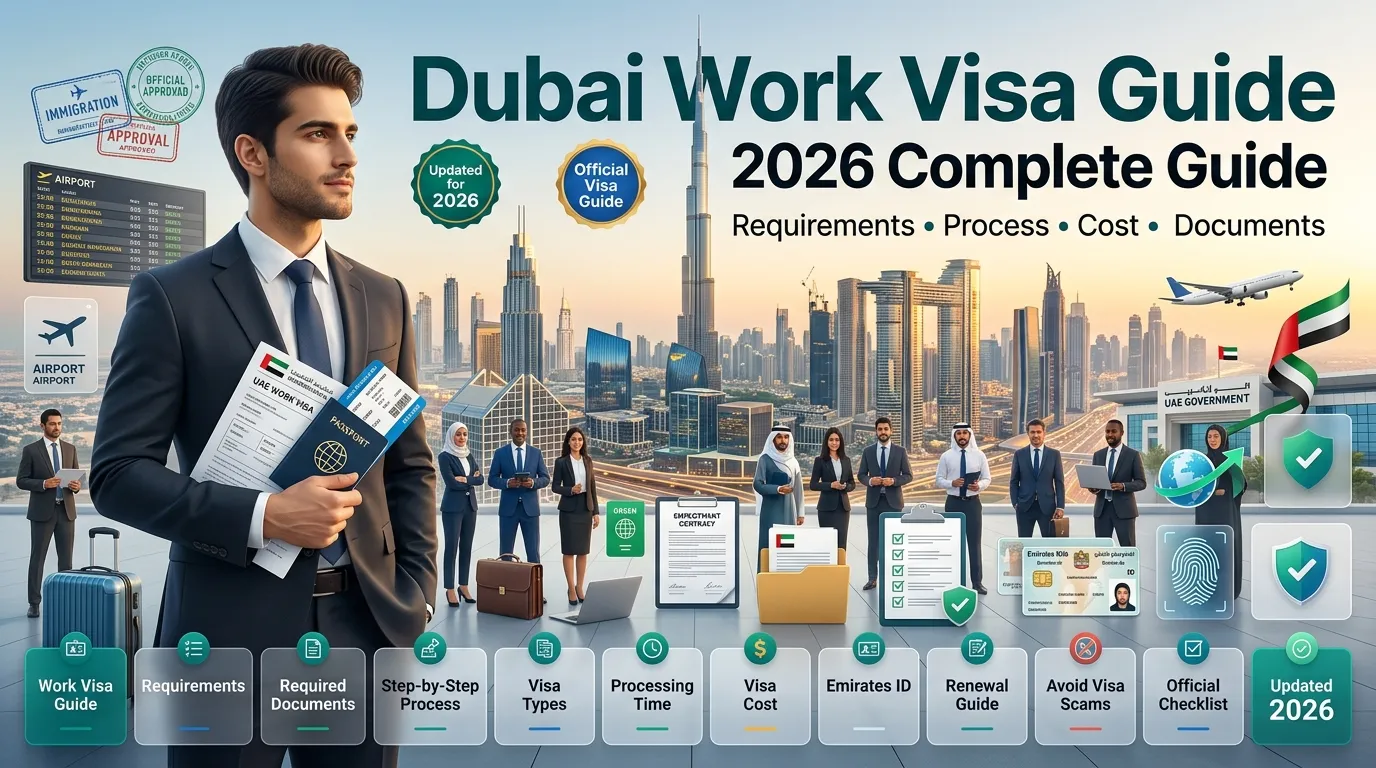
*Employer-sponsored employment visa, typical all-in range — see the full cost breakdown below.
What Is a Dubai Work Visa?
Strip away the paperwork and a Dubai work visa is really three approvals stacked on top of each other: a work permit from MOHRE that says you’re allowed to hold this specific job, an entry permit that gets you into the country, and a residence visa that lets you stay. Most people lump all three under the phrase “work visa” — technically not one document, but a bundle of them tied to one employer.
Work Visa vs Employment Visa vs Labour Card
These three terms get used interchangeably, which causes more confusion than it should. The labour card is issued by MOHRE and confirms your right to work for a specific company. The employment visa is the immigration side — it gets you a residence stamp in your passport. In everyday conversation, “work visa” usually means both together.
- Who Sponsors It: In almost every standard case, the hiring company is your sponsor and files the bulk of the paperwork — you’re mostly signing documents and showing up for appointments.
- Why It’s Required: Working on a tourist visa, even for a “quick project” or informal arrangement, is not legal in the UAE and carries real fines if caught.
Who Needs a Dubai Work Visa?
- Foreign Workers: Anyone from outside the UAE taking up employment needs a sponsored work visa before the first day on the job — not after.
- GCC Nationals: Citizens of other Gulf Cooperation Council countries have a simpler entry and residency path than other foreign nationals — worth confirming the current specifics for your country with your employer’s PRO.
- Residents Changing Jobs: Already living in the UAE doesn’t carry over — moving employers usually means a new labour contract and a new visa transfer or reissue.
- Freelancers: No standard employment visa here. Freelancers go through a free-zone freelance permit or the Green Visa route instead, each with its own paperwork.
Amir, a marketing manager from Karachi, accepted an offer from a Dubai media agency in March. His HR team filed the work permit within the first week, but Amir assumed he could start remotely while waiting for the visa to clear. His new manager had to explain that working from Pakistan on the company payroll, before the visa was issued, wasn’t something the agency could legally do — Amir ended up starting three weeks later than planned, simply because nobody had told him the permit has to be fully issued before day one, not just “in progress.”
Types of Dubai Work Visas
💼 Employment Visa
🌿 Green Visa
⭐ Golden Visa
🧑💻 Freelance Visa
⏳ Temporary Work Permit
🕐 Part-Time Work Permit
✈️ Mission Visa
Employment vs Golden vs Green Visa — Quick Comparison
| Factor | Employment Visa | Golden Visa | Green Visa |
|---|---|---|---|
| Who sponsors it | Employer | Self | Self |
| Tied to one employer? | Yes | No | No |
| Validity | 2–3 years | 10 years | 5 years |
| Job loss = visa loss? | Usually, after a grace period | No | No |
| Typical candidate | New hire, standard salaried role | Investors, specialists, top-tier professionals | Freelancers, self-employed, skilled independents |
For a broader look at industries and roles hiring right now, see our Jobs in Dubai guide.
Eligibility Requirements
Documents Required
| Document | Notes |
|---|---|
| Passport | Original, with sufficient remaining validity |
| Passport Photos | Passport-size, per official specifications |
| Job Offer Letter | Issued by the sponsoring employer |
| Employment Contract | Signed by both parties |
| Educational Certificates | Attested, where applicable to the role |
| Medical Test Results | Completed after arrival in the UAE |
| Emirates ID Application | Submitted alongside biometrics |
| Entry Permit | If applicable, arranged before travel |
Step-by-Step Application Process
Timeframes are typical ranges for a straightforward case, not guarantees — your employer’s PRO can confirm where things stand at each step.
Medical Test
The medical fitness test happens at an approved government health center, usually within the first few days after you land. It’s quick — a blood test and chest X-ray in most cases — and clearing it is what unlocks the next step, Emirates ID registration. Test fees typically run somewhere around AED 300–700 depending on the emirate and category, and results are often ready the same day or within 48 hours.
Emirates ID
- What It Is: A mandatory biometric national ID card for every UAE resident, including work visa holders — not optional, not something you can skip.
- Why It Matters: You’ll be asked for it to open a bank account, sign a tenancy contract, or even pick up a courier package — it functions as your primary ID inside the country.
- Application Process: Fingerprints and a photo are captured at an approved typing center or ICP service center, usually on the same visit as your medical test appointment window.
- Cost: Typically around AED 100–370 depending on the validity period chosen (1, 2, or 3 years), on top of typing center service fees of roughly AED 30–100.
- Validity: Matches your residence visa period, so the two get renewed together.
Processing Time
| Step | Typical Time |
|---|---|
| Work Permit (MOHRE) | 3–7 working days |
| Entry Permit | 2–5 working days |
| Medical Test Results | Same day (express) to 2 days |
| Emirates ID Biometrics & Card | 3–5 working days after biometrics |
| Residence Visa Stamping | 3–7 working days |
| Total, offer to stamped visa | ~2–4 weeks |
These are typical ranges for a clean, complete application — missing documents or a backlog at a particular typing center can push any single step past what’s listed here. Ask your employer’s PRO for the status rather than assuming a delay means something has gone wrong.
Visa Costs — 2026 Breakdown
Employers are required to cover the core visa-related costs for a sponsored employee under UAE labour rules — this is one of the more reassuring facts in the whole process, and it’s worth knowing so you can spot a company that’s trying to shift costs onto you instead.
| Item | Typical Cost (AED) | Usually Paid By |
|---|---|---|
| Work Permit / Labour Card | ~600–2,000 | Employer |
| Entry Permit | ~200–600 | Employer |
| Medical Test | ~300–700 | Employer |
| Emirates ID (2-year) | ~370 + typing fee | Employer (varies by contract) |
| Residence Visa Stamping | ~500–1,600 | Employer |
| Typical Total (Employment Visa) | ~3,000–7,000 | Employer |
Figures are illustrative 2026 ranges compiled for general planning — free zone vs mainland authority, company size, and visa duration all shift the exact number. Confirm the specific figure for your offer with HR before signing anything.
Sponsoring Family (Dependents)
Once your residence visa is active, you can typically sponsor your spouse and children, provided your salary clears the minimum threshold set by immigration authorities — commonly cited as around AED 4,000 per month, or AED 3,000 if your employer also provides accommodation. Below that line, family sponsorship generally isn’t available regardless of how badly you’d like to bring them over.
- Spouse: Requires an attested marriage certificate alongside the standard document set.
- Children: Requires attested birth certificates; there are age-related conditions for sponsoring adult children, particularly sons.
- Typical Cost: Roughly AED 3,000–5,000 per dependent, covering entry permit, medical test, Emirates ID and visa stamping — paid by the sponsoring employee, not the employer.
Farah, an accountant who relocated from Lahore, assumed her AED 3,800 salary with no housing allowance would qualify her to sponsor her two kids. It fell just under the threshold that applies without employer-provided accommodation, and she had to renegotiate her offer to include a housing allowance before family sponsorship became possible — a conversation that would have been easier to have before she’d already accepted the role.
Visa Renewal
- When It Happens: Renewal is typically initiated 30 days or so before the current visa’s expiry date — not something to leave until the last week.
- Employer’s Role: For employer-sponsored visas, the company generally handles the renewal application and associated steps, including the renewed labour contract.
- Required Documents: Usually an updated passport, renewed labour contract, and sometimes a fresh medical test, depending on the visa type.
- Cost: Broadly similar to the initial issuance cost, since most of the same steps are repeated.
Changing Jobs
- Resignation: Follows the notice period set out in your employment contract — usually 30 to 90 days.
- New Employer Sponsorship: Your new employer sponsors a new labour card and residence visa; there’s often a short gap where you hold neither an active job nor an active visa, so timing this transition matters.
- Visa Transfer vs Cancellation: Depending on timing, your previous visa may be cancelled before the new one is issued, or transferred directly — this depends on your specific situation and both employers’ processes.
Visa Cancellation
- Leaving the UAE: Requires formal visa cancellation through your sponsor before departure in most cases.
- Grace Period: Cancellation typically comes with a 30-day grace period during which you can remain in the UAE to arrange your next steps, whether that’s a new job or travel home.
- Final Settlement: Includes final salary and gratuity (end-of-service benefit), calculated based on years of service — confirm the figure your employer owes you before signing any cancellation paperwork.
Common Reasons for Delay
- Missing Documents: Incomplete submissions are the single most frequent cause of processing delays — double-check the documents table above before submitting anything.
- Name Mismatches: Even a small spelling difference between your passport and a certificate can trigger a hold until it’s corrected.
- Employer-Side Delays: Sometimes the holdup sits with the employer’s internal HR or PRO workflow rather than the government processing time.
- Typing Center Backlogs: Appointment availability at busy typing centers can add several days that have nothing to do with your application itself.
Common Mistakes to Avoid
Avoid Job Visa Scams
- Never pay upfront for a “guaranteed” visa or job placement — this is the single most common Dubai job scam.
- Verify the employer’s trade license independently before sharing passport copies or other personal documents.
- Be cautious of offers that arrive only through WhatsApp or informal messaging with no official offer letter or contract.
- Read every contract clause before signing, especially anything about who bears visa or relocation costs.
Frequently Asked Questions
Anyone outside the UAE with a confirmed job offer from a company licensed in the UAE. The employer files the paperwork on your behalf, so the process starts with them, not with you standing in a queue somewhere.
Not through the standard employment route. Without an offer, your options are the Green Visa (self-sponsored, for freelancers and skilled independents) or a free-zone freelance permit, both of which follow a different application path.
For an employer-sponsored employment visa, all-in government and typing-center costs typically fall around AED 3,000 to 7,000, and this is usually paid by the employer, not the employee.
Budget 2 to 4 weeks from job offer to a stamped residence visa in a straightforward case — see the processing time table above for a step-by-step breakdown.
Employers are required to cover the core visa-related costs for sponsored employees. If a company asks you to pay for your own work visa upfront, treat that as a warning sign worth questioning.
Yes. You serve the notice period in your contract, your new employer applies for a new labour card and residence visa, and depending on timing your old visa is either cancelled first or transferred directly.
Yes, once your salary meets the minimum threshold set by immigration authorities (commonly cited around AED 4,000 with accommodation, or AED 3,000 plus employer-provided accommodation), you can sponsor a spouse and children.
An expired visa brings fines and can restrict travel — renewal should start around 30 days before expiry, not after.
No — starting work, even remotely on the local payroll, before the permit and visa are properly issued isn’t authorized.
Yes, through a free-zone freelance permit or the Green Visa route, rather than a standard employment visa.
Yes — cancellation is typically tied to the end of employment, and it comes with a grace period (commonly 30 days) to arrange your next move.
Passport, job offer, signed contract, attested certificates where relevant, medical test results, and the Emirates ID application — the full table above breaks down notes for each.
- Compiled and reviewed by the NearbyFinders Careers Team from publicly available MOHRE and ICP guidance.
- Cost and timeline figures are general 2026 ranges for planning purposes, always confirm exact numbers with your employer’s PRO or the relevant government channel before budgeting around them.
- This guide is general information, not legal advice.

Written & Reviewed by Asad Bukhari
Asad moved to Dubai over 20 years ago to work as a newspaper reporter covering city and relocation news, and has been reporting on the city ever since. Over the years he expanded that first-hand knowledge of Dubai’s neighbourhoods and relocation process into his own real estate business, which he still runs today. This guide draws on both his journalism background and his hands-on property experience.
Pingback: Dubai CV Format 2026: Guide, ATS Tips & Common Mistakes
Pingback: Ejari Registration Guide (2026): How to Register Your Tenancy Contract in Dubai
Pingback: Airport Jobs in Dubai 2026: Salaries, Roles & How to Apply
Pingback: Warehouse Jobs in Dubai 2026: Salaries & How to Apply
Pingback: Driver Jobs in Dubai 2026: Salaries, UAE License & How to Apply
Pingback: Ultimate Dubai Relocation Checklist (2026): Free Tools & Calculators