
Dubai Public Transport Finder: Bus, Metro & Tram Routes and Live Search Tool (2026)
I’ve lived in Dubai for more than two decades, and for most of that time I haven’t owned a car by choice. Not because I can’t — because I genuinely don’t need one. Between the Metro, the Tram, and the RTA bus network, all running off the same Nol card, I can get from a viewing in Al Barsha to a client meeting in DIFC and still make it home for dinner in Deira without ever hailing a cab. This page is everything I’ve learned doing that, almost every day, for twenty years — plus a live search tool that covers all three networks so you don’t have to carry three different mental maps around like I did when I first got here.
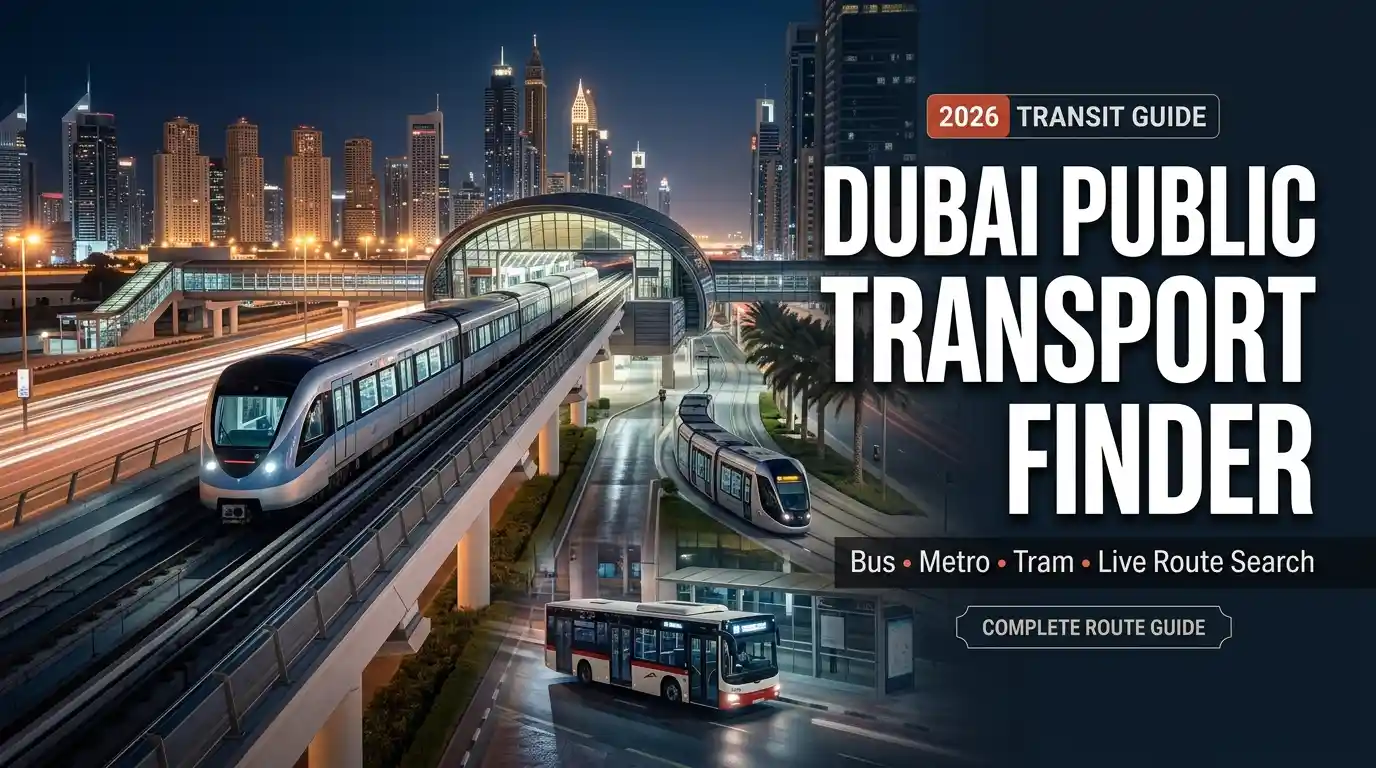
What took me years to figure out is that the three networks aren’t really three separate systems you have to choose between — they’re built to hand off to one another, and once that clicks, the whole city opens up. The Metro’s two lines cross at Union and BurJuman; the Tram feeds directly into the Red Line at Sobha Realty and DMCC stations; and the feeder buses quietly close the last-mile gap between wherever you actually live and the nearest station. Search the tool below by area, line, or route number, and every result links straight to a map so you can see exactly where you’re headed.
Overview: Three Networks, One Card, and a Learning Curve I Wish I’d Skipped
Almost every “how do I get around Dubai” conversation I’ve had with newcomers over the years comes down to the same realisation I had myself: you’re not picking one mode and sticking with it, you’re combining all three depending on the trip. The Metro is my go-to for anything long and east–west — along Sheikh Zayed Road, across to the airport, or cutting through old Dubai. The Tram is the right call specifically for the Marina, JBR, and Palm Jumeirah stretch, and nowhere else — I learned that the hard way the first time I assumed it would take me downtown. And the buses are what actually get me the last kilometre or two, into neighbourhoods the rail lines were never going to reach economically, which in a city as spread out and low-rise as Dubai is most of it.
For official RTA service updates, planned works, and anything time-sensitive, the RTA website is the source I check first, and I’d genuinely recommend cross-checking it against anything on this page too — schedules and fares do shift from year to year.
Dubai Metro: Red Line & Green Line
The Metro is the backbone of how I move around this city, and it has been since the day it opened back in 2009. It’s a fully automated, driverless system now running 55 stations across two lines spanning close to 90 km, and both lines alternate between underground stretches through the city centre and elevated viaducts everywhere else. Every station is air-conditioned — genuinely one of the small mercies of living somewhere that hits 45°C in August — and platform edge doors keep things safe even during rush hour crowding.
Red Line (35 stations) — my everyday line
The Red Line is the one I use most, simply because it runs largely parallel to Sheikh Zayed Road, which is where most of Dubai’s business actually happens. It stretches from Centrepoint, near Al Rashidiya and the airport, all the way down to Jebel Ali, where it splits into two branches — one continuing to Life Pharmacy, the other, Route 2020, extending out to Expo City Dubai. In one line, it connects the airport, DIFC, Downtown, Dubai Marina, and JLT, which covers most of the property viewings I do in a given week.
Green Line (20 stations) — the old-Dubai line
The Green Line stays within historic Dubai, running from e& (Etisalat) in the north through Deira and Bur Dubai down to Creek, passing the Gold Souq, Spice Souk, and Dubai Healthcare City along the way. This is the line I take when I’m meeting clients in the older parts of the city, or when I just want a cheap, air-conditioned way to wander the souks on a weekend. It crosses the Red Line at two interchange stations: Union and BurJuman.
| Line | Stations | Termini | Key Interchanges |
|---|---|---|---|
| Red Line | 35 | Centrepoint ↔ Expo 2020 / Life Pharmacy | Union, BurJuman (Green Line); Sobha Realty, DMCC (Tram) |
| Green Line | 20 | e& (Etisalat) ↔ Creek | Union, BurJuman (Red Line) |
Dubai Tram
The Tram opened in 2014, and I’ll be honest — for years I barely used it, because I don’t live or work along its corridor. It runs 11 stations along a 10.6 km stretch of Al Sufouh Road, covering Dubai Marina, JBR, and the Al Sufouh corridor through to Palm Jumeirah. It’s not trying to be a citywide network like the Metro, and it shouldn’t be judged as one. Where it genuinely shines is if you’re staying in a Marina hotel, showing a client an apartment in JBR, or spending a weekend on the Palm — for that specific stretch of coastline, it’s the most relaxed way to get around, and the sea views from the elevated sections don’t hurt either.
Two Tram stations connect directly into the Metro Red Line, which is the detail most first-time visitors miss: Dubai Marina station links to Sobha Realty Metro station, and Jumeirah Lakes Towers links to DMCC Metro station. There’s also a third connection linking Palm Jumeirah tram station to the Palm Monorail’s Palm Gateway stop, if you’re continuing on to Atlantis or the Pointe.
Dubai Bus Network
This is the part of the network most tourists never touch and most residents can’t live without. RTA buses provide the last-mile connectivity the two rail networks simply can’t — residential streets, industrial areas, and suburbs a fixed rail line will never justify economically. Over the years I’ve come to think of the network in a few informal buckets: standard city routes (plain numbers like 8, 27, 44), feeder routes to Metro/Tram stations (prefixed F, like F13 or F55), express/intercity routes (prefixed X or E, like X28 or E101 to Abu Dhabi), and circular community routes tied to a specific area, like J01 looping through JVC.
Most stops are air-conditioned now, which genuinely changed my relationship with buses here — waiting in the open in July used to be its own kind of punishment. Every Metro and Tram station also has at least one feeder bus route serving it directly, which is the detail that made me stop assuming “no Metro nearby” meant “no easy way there.”
The Dubai Public Transport Finder Tool
This is the tool I built for exactly the problem I used to have myself: switching between three mental maps depending on which mode I needed. Switch between Bus, Metro, and Tram below, then filter by area, line, or route/station name. Every entry links straight to a map view of that exact stop or station, so you can see precisely where you’re headed before you leave the house.
Bus Routes in Dubai
Fares & the Nol Card
Every mode — Metro, Tram, and bus — runs on the same Nol card system, and none of the three accept cash. You tap in and tap out (Metro/Tram) or tap in only (bus), and the fare is deducted automatically. I still remember standing at a Union Station gate in my first month with a fistful of dirhams, holding up the line behind me because I hadn’t figured out yet that cash simply isn’t a thing here.
Metro & Bus Fares (Zone-Based, Silver Nol Card)
| Travel Tier | Fare (Silver Card) |
|---|---|
| Within 1 zone | AED 3.00 |
| Across 2 zones | AED 5.00 |
| 3 or more zones | AED 7.50 |
Dubai’s fare map is divided into 7 zones, and your fare is calculated automatically based on how many zones your specific trip crosses — you don’t have to work it out yourself, the gate does it the moment you tap out.
Tram Fare
The Tram uses a flat fare regardless of distance travelled — roughly AED 3 with a Silver Nol card for the full line end to end, which honestly makes it one of the best-value rides in the city if you’re already going that way.
What My Actual Daily Commute Looks Like
To make all of this concrete rather than theoretical, here’s roughly how a normal work day breaks down for me. If I have a viewing in JLT and a client meeting in DIFC on the same day, I’ll take the Red Line from my nearest station straight to DMCC, walk the client through the property, then hop back on the Red Line toward Financial Centre. Door to door, that’s usually under 40 minutes each way, and I’ve never once had to think about parking, which in DIFC alone can eat a good chunk of a coffee-shop-meeting’s worth of time and money.
On weeks when I’m covering old Dubai — Deira, Bur Dubai, the souks — I switch to the Green Line entirely, and if the meeting’s somewhere the Metro won’t reach directly, I lean on a feeder bus for the last stretch rather than paying for a taxi I don’t need. The one exception is very early morning viewings before the Metro opens for the day — for those, I’ll admit, a taxi is the only realistic option.
Public Transport vs Taxi: What It Actually Costs Me
People are often surprised when I tell them the real numbers, so here’s the honest comparison based on trips I make regularly. A Red Line ride from Rashidiya to Dubai Marina — pretty much the full length of the line — costs AED 7.50 on a Silver Nol card. The same trip by taxi or ride-hailing app, depending on traffic and time of day, typically runs somewhere between AED 45 and AED 70. Multiply that difference by two trips a day, five days a week, and it adds up to a genuinely large amount of money over a year — enough that I’ve never seriously considered switching back to driving myself, even after I could easily afford to.
Where a taxi still wins for me is convenience for very short, very late-night, or multi-stop trips — carrying moving boxes between two apartments, for instance, isn’t something I’d ever try to do on the Metro. But for the bulk of ordinary point-to-point travel across the city, public transport wins on cost by a wide margin, and it’s rarely much slower once you factor in Sheikh Zayed Road traffic at peak hours.
Practical Tips for Using All Three Networks
- Check the interchange, not just the line: if your trip needs Red Line to Green Line, you only transfer at Union or BurJuman — there’s no shortcut between them elsewhere.
- Use the Tram only where it actually helps: it’s built for the Marina/JBR/Sufouh corridor, not as a citywide alternative to the Metro.
- Check feeder bus timing against train arrivals: feeder buses are timed to Metro arrivals at most stations, so missing one by a couple of minutes can mean a longer wait than the ride itself.
- Keep your Nol balance above AED 7.50: that’s the minimum most gates require to let you check in, regardless of how short your trip is.
- Download the RTA app (S’hail): live train and bus timings are more reliable there than relying on posted schedules, especially for buses.
- Avoid the first Metro carriage during peak hours if you’re standing: the Gold Class cabin sits at the front on most trains, and standard-ticket riders caught there are fined — I’ve seen it happen to a visiting friend.
- Ride the front carriage for the view, not the crowd: the driverless front window on quieter off-peak trips gives one of the best free views in the city, especially on the elevated stretch past Marina.
Common Mistakes (Including a Few of My Own)
What’s Coming: Blue Line and Gold Line
Two expansions are already under construction, and I’m watching both closely because they’ll change how I plan routes for clients on the eastern and western edges of the city. The Blue Line will add 14 stations linking Creek to Academic City, due to open in 2029, and it should finally give the growing communities around Academic City and Silicon Oasis a direct rail connection rather than a bus-only commute. The Gold Line, with 18 stations from Al Ghubaiba to Jumeirah Golf Estates and targeted for 2032, will stretch the network much further west than it currently reaches. Neither is running yet, so treat any current-day route planning around them as forward-looking rather than usable today — I’ll update this guide the moment either opens for passengers.
Frequently Asked Questions
Yes. A single Nol card is used to check in and out on the Metro, the Tram, and all RTA buses, plus the Dubai Ferry and paid parking, so you only ever top up one card.
Two lines are currently open: the Red Line (35 stations, Centrepoint to Life Pharmacy plus the Expo City branch) and the Green Line (20 stations, e& to Creek). A Blue Line and a Gold Line are under construction.
11 stations, running along Al Sufouh Road from Dubai Marina and JBR through to Al Sufouh, with interchanges to the Metro Red Line at Dubai Marina and JLT.
Fares are zone-based on a Silver Nol card: AED 3 within one zone, AED 5 across two zones, and AED 7.50 for three or more zones.
The tram has a flat fare regardless of distance, roughly AED 3 with a Silver Nol card.
No. All three networks are cashless — you need a Nol card or Nol paper ticket with sufficient balance to travel.
Sobha Realty station connects to the Tram’s Dubai Marina stop, and DMCC station connects to the Tram’s Jumeirah Lakes Towers stop.
At two interchange stations: Union and BurJuman, both in the Deira/Bur Dubai area.
Yes, RTA runs a large network of feeder buses (routes with codes like F13, F30, F55) that connect residential areas to the nearest Metro or Tram station.
Generally around 5am to midnight on weekdays, with later hours on some nights and shorter hours on Friday mornings — always confirm on the RTA app since timings shift periodically.
Metro and Tram stations are built with elevators and tactile paths for accessibility, and people of determination can travel free with a personalised Nol card.
High-frequency routes like C01 (Airport to Satwa), 8 (Al Ghubaiba to Ibn Battuta via Jumeirah), and X28 (Al Qusais to Dubai Internet City) carry some of the heaviest daily ridership.
In almost every case, yes, and often by a wide margin. A cross-city Metro trip that costs around AED 7.50 can easily cost AED 40-60 or more by taxi or ride-hailing app at the same time of day.
Yes. A Red Ticket paper Nol card can be bought at any station vending machine with cash or card, and stations are signposted in both English and Arabic, with announcements in English on board.
- Metro and Tram station lists, line lengths, and interchange points are compiled from RTA network data and cross-checked against publicly documented station records at the time of writing.
- Fares, zones, and Nol card details reflect published RTA tariffs at the time of writing and are subject to change — confirm current pricing on the RTA app or website before travelling.
- Bus stop coordinates are approximate, intended for general map orientation rather than survey-precise navigation.
- Personal commute times, costs, and anecdotes in this guide reflect my own routine use of the network and will naturally vary by trip, time of day, and traffic conditions.

Written & Reviewed by Asad Bukhari
Asad moved to Dubai over 20 years ago to work as a newspaper reporter covering city and relocation news, and has been reporting on the city ever since. Over the years he expanded that first-hand knowledge of Dubai’s neighbourhoods and transport network into his own real estate business, which he still runs today. This guide draws on both his journalism background and his day-to-day experience actually riding this network for two decades.

Pingback: Living in International City Dubai (2026): Area Guide