
Rent vs Buy in 2026: Which Is Better? Real Cost & Break-Even Guide
Should I rent or buy? It’s one of the most searched housing questions in the world, and almost everyone reaches this fork in the road eventually — sign another lease, or take on a mortgage and buy. This guide compares renting a house vs buying, buying property vs renting, and rent vs mortgage across every angle: real monthly costs, hidden fees, a working rent vs buy calculator, a break-even analysis, a decision tree, and country-by-country breakdowns for first-time home buyers and long-term residents alike. I’ve gone through this exact decision myself, twice, in two different countries — and the honest answer both times came down less to a spreadsheet and more to how certain I actually was about staying put.
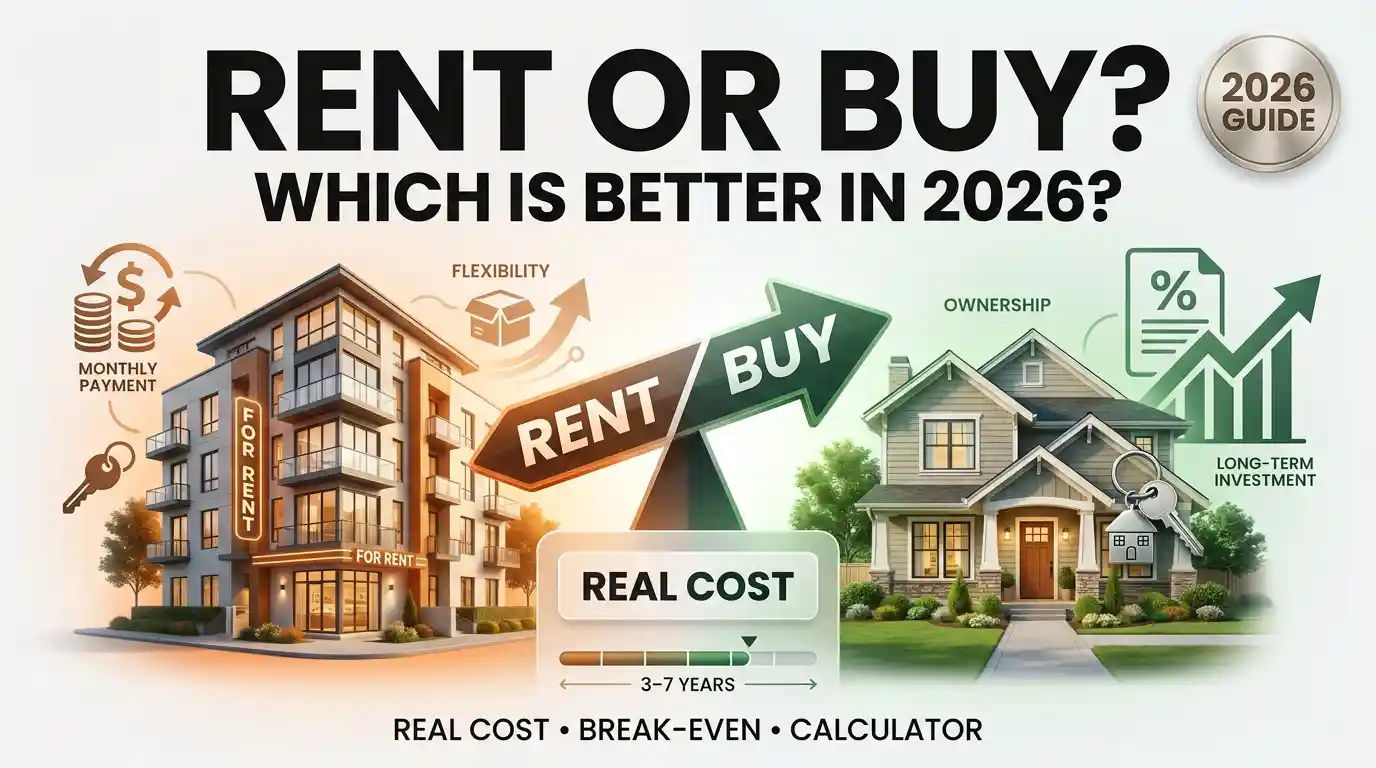
Overview: Why This Decision Is So Personal
There is no single correct answer to “should I rent or buy” — anyone who tells you otherwise is speaking from their own circumstances, not yours. A 26-year-old consultant who relocates every 18 months has a completely different optimal answer than a 40-year-old with two kids in a stable job planning to stay in one city for a decade. This guide is built around that reality. Instead of pushing you toward one option, it walks through real monthly numbers, hidden costs, mortgage mechanics, a working calculator, a break-even analysis, and lifestyle-specific scenarios so you can map your own situation onto the data. For a genuinely independent, government-backed take on the same question, the UK’s MoneyHelper service covers similar ground with no product to sell either way, which is part of why I tend to point people there alongside this guide.
Whether you’re weighing renting a house vs buying for the first time, comparing rent vs mortgage payments, or researching as a first-time home buyer, this guide — and its linked country pages, including Renting vs Buying in Dubai and Renting vs Buying in the USA — is designed to be the single reference you keep coming back to.
1. What Does Renting Mean?
Renting means paying a landlord a recurring monthly fee for the right to live in a property you do not own. It’s the lower-commitment path into housing and how most people start their independent living journey, regardless of country.
- Monthly Rent: A fixed recurring payment, agreed for the lease term and paid monthly, quarterly, or via post-dated cheques in some markets.
- Lease Agreement: A binding contract defining rent amount, duration, renewal terms, and both parties’ obligations.
- Security Deposit: An upfront, refundable amount (often one month’s rent) held against damage or unpaid rent.
- Landlord Responsibilities: Structural repairs and major appliance failures typically fall on the landlord.
- Tenant Rights: Vary by jurisdiction but generally include protection from unlawful eviction and the right to a habitable property.
2. What Does Buying Mean?
Buying means purchasing legal ownership of a property, usually financed through a mortgage. Ownership shifts your monthly payment from rent to a mix of loan repayment, interest, taxes, and insurance — and each payment slowly builds equity that belongs to you. The U.S. Consumer Financial Protection Bureau has a genuinely useful step-by-step breakdown of this process if you want a government source to cross-check anything here against.
- Own Property: Once the transaction closes, the property legally belongs to you, subject to the lender’s claim until the loan is repaid.
- Mortgage: A long-term loan, typically 15-30 years, secured against the property itself.
- Down Payment: The upfront cash portion you pay yourself, commonly 10-25% depending on country and loan type.
- Equity: The portion of the property’s value you own outright, growing as you pay down principal and if the property appreciates.
- Ownership: Full control over the property, but also full responsibility for upkeep, taxes, and insurance.
The Rent Path vs The Buy Path
🔑 Renting
🏠 Buying
3. Renting vs Buying: Full Comparison Table
| Factor | Renting | Buying |
|---|---|---|
| Monthly Cost | Fixed rent, predictable | Mortgage + tax + insurance, can vary |
| Upfront Cost | Low (deposit + fees) | High (down payment + closing costs) |
| Maintenance | Landlord’s responsibility | Owner’s responsibility |
| Flexibility | High — easy to relocate | Low — selling takes time |
| Long-Term Savings | None built automatically | Builds via equity over time |
| Investment Potential | None (payments don’t return) | Possible appreciation + rental income |
| Freedom to Customize | Limited, landlord approval needed | Full control, renovate as desired |
| Taxes | Usually none directly | Property tax, sometimes transfer tax |
| Insurance | Optional contents insurance | Often mandatory home/mortgage insurance |
| Utilities | Tenant-paid, sometimes partially included | Fully owner-paid |
| Selling Difficulty | Not applicable | Can take weeks to months |
| Moving | Simple, end of lease | Complex, involves sale process |
| Best For | Short stays, flexibility seekers | Long stays, equity builders |
4. Pros & Cons: Renting
✅ Pros of Renting
- Lower upfront cost — no down payment or closing costs
- Easy relocation when a job or life change comes up
- No repair or major maintenance expenses
- Well suited to expats and short-term residents
- Flexible lease terms in most markets
- Less financial risk if the property market drops
⚠️ Cons of Renting
- No ownership stake — payments don’t build equity
- Rent increases at renewal, often above inflation
- Landlord restrictions on pets, renovations, subletting
- No long-term equity or appreciation benefit
- Limited ability to customize or personalize the space
5. Pros & Cons: Buying
✅ Pros of Buying
- Builds equity with every mortgage payment
- Functions as a long-term investment vehicle
- Stable, predictable payments with a fixed-rate mortgage
- Full freedom to renovate and personalize
- Potential for property value appreciation over time
- Option to generate rental income if you relocate later
⚠️ Cons of Buying
- Requires a large upfront down payment
- Long-term debt obligation via the mortgage
- Ongoing property taxes in most jurisdictions
- Owner is fully responsible for maintenance costs
- Selling a property takes time and isn’t guaranteed at your target price
- Exposed to market risk if property values decline
6. Monthly Cost Comparison & The Real Cost Formula
The headline rent or mortgage number is never the full monthly picture. Renters often forget utilities and parking; buyers often forget HOA fees, property tax, and a realistic maintenance reserve. This is the single biggest gap I see people fall into — they compare an advertised mortgage payment straight against rent, without ever pricing in the four or five line items that sit underneath it.
| Cost Item | Renting | Buying |
|---|---|---|
| Base Payment | Rent | Mortgage (Principal + Interest) |
| Insurance | Optional contents insurance | Home/mortgage insurance often mandatory |
| Utilities | Tenant-paid | Owner-paid |
| Maintenance | Landlord-covered | Owner reserve, ~1% of value/year |
| HOA / Service Charges | Rare, occasionally included | Common in apartments/gated communities |
| Property Tax | Not applicable | Billed annually or monthly-escrowed |
| Parking | Sometimes extra | Sometimes extra or included |
| Internet | Tenant-paid | Owner-paid |
| Emergency Repairs | Landlord’s responsibility | Owner’s responsibility |
A $400,000 home with a 20% down payment ($80,000) financed over 30 years at roughly 6.5% interest works out to approximately $2,020/month in principal and interest alone. Add an estimated $370/month property tax, $100/month insurance, and a $330/month maintenance reserve (about 1% of value per year), and the realistic monthly cost lands closer to $2,820. A comparable rental in the same neighborhood might run around $2,000/month. Figures are illustrative only — always confirm current local rates before deciding.
7. Hidden Costs on Both Sides
Hidden Costs of Renting
- Application Fee: A non-refundable screening fee in many markets.
- Moving Costs: Movers, truck rental, or shipping.
- Security Deposit: Typically one to two months’ rent.
- Broker/Agency Fee: Often a percentage of annual rent.
- End-of-Lease Cleaning: Frequently required before deposit refund.
- Utility Set-Up: Connection fees and deposits.
- Pet Deposit: An extra deposit or monthly pet rent in many markets.
- Parking Fee: Not always bundled into the base rent.
- Furniture: A real cost if the unit is unfurnished.
- Lease Renewal Fee: Some landlords or agents charge an admin fee at renewal.
- Internet Installation: A one-time setup charge in most homes.
Hidden Costs of Buying
- Closing Costs: Typically 2-5% of the purchase price.
- Registration/Transfer Fees: Government charges to register the property.
- Legal Fees: Conveyancing or attorney fees.
- Maintenance Reserve: Often 1% of property value per year.
- Insurance: Home insurance, plus mortgage protection insurance if required.
- Property & Transfer Taxes: Recurring annual tax plus one-time transfer tax.
- HOA/Service Fees: Recurring community or building charges.
- Inspection Fee: A pre-purchase property inspection, usually a fixed one-time cost.
- Valuation Fee: Charged by the lender to formally value the property.
- Mortgage Processing Fee: An administrative fee to originate the loan.
- Mortgage Insurance (PMI): Required by many lenders when the down payment is below 20%.
- Early Repayment Penalty: A charge some lenders apply if you pay off or refinance early.
- Renovation Costs: Personalizing a home to your taste is entirely on you.
For a full breakdown of recurring bills once you’ve moved in, see our DEWA & utility bills guide, our Ejari registration guide, and our cost of living guide.
8. Mortgage Basics: What Buyers Should Understand
A mortgage is a loan secured against the property — if you stop repaying it, the lender can legally reclaim (foreclose on) the property.
- Principal: The original loan amount after your down payment.
- Interest Rate: The lender’s charge for borrowing, fixed or variable.
- Loan Term: Commonly 15, 20, or 30 years.
- Amortization: Early payments lean toward interest; later payments shift toward principal.
- Pre-Approval: A lender’s conditional commitment before you start house-hunting.
- Loan-to-Value (LTV): The loan as a percentage of property value — lower LTV usually secures a better rate.
9. Statistics Worth Knowing
These figures are widely-cited industry ranges intended to give context, not precise real-time data — the OECD Affordable Housing Database is a genuinely useful cross-country reference if you want to check current figures for a specific market rather than a global average.
Sources: figures are broad, illustrative ranges compiled from typical housing-authority and central-bank reporting patterns across major markets; consult your local housing authority or the OECD Affordable Housing Database above for verified statistics.
10. Break-Even Analysis: When Does Buying Start Paying Off?
The break-even point is the moment the cumulative cost of buying (down payment + monthly costs, offset by equity built) becomes cheaper than the cumulative cost of renting over the same period. It depends heavily on local price-to-rent ratios, but here’s a general pattern seen across many markets:
| Time Horizon | Typical Outcome |
|---|---|
| Under 3 years | Renting almost always wins — closing costs and transaction fees aren’t recovered yet. |
| 3-5 years | Break-even zone in many markets — outcome depends heavily on local price-to-rent ratio. |
| 5-7 years | Buying typically starts pulling ahead as equity and any appreciation accumulate. |
| 7-10+ years | Buying usually wins clearly in most stable markets, assuming steady payments and no forced early sale. |
11. Decision Tree: Should You Rent or Buy?
12. Decision Checklist
13. When Renting Is Better
Buying isn’t always the smart move, even for people who can technically afford it. Renting makes more financial and practical sense when:
- Your job is unstable or you’re in an industry with frequent layoffs or relocations.
- You’re moving soon — under 3 years in one city rarely justifies transaction costs.
- You’re a student with no long-term location commitment yet.
- You’re a digital nomad whose lifestyle depends on location independence.
- You’re a new expat still learning the neighborhoods, market, and local rules.
- You don’t have a real emergency fund beyond the down payment itself.
- You value flexibility over building equity at this stage of life.
14. When Buying Is Better
Buying tends to make sense once your life circumstances line up with a longer, more stable horizon:
- You have a stable job with predictable, secure income.
- You’re settled with a family and schooling or community factors matter.
- You plan a long stay — 5+ years in the same city or region.
- You’re specifically pursuing property as an investment with clear yield expectations.
- You have both the down payment and a separate emergency fund ready.
- You want full control to renovate, extend, or personalize the property.
15. Common Mistakes to Avoid
16. Timelines: What to Expect
Buying Timeline
Renting Timeline
17. Investment Value: Does Buying Really Build Wealth?
- Forced Savings Effect: A mortgage payment builds equity regardless of market movement, unlike rent.
- Appreciation Is Not Guaranteed: Property values can stagnate or fall for years in specific cycles.
- Opportunity Cost: The down payment could instead be invested elsewhere — a fair comparison weighs what that capital could otherwise earn.
- Rental Income Potential: Owners who relocate can sometimes rent the property out, turning it into an income stream.
- Renting Isn’t “Wasted Money”: Rent buys flexibility and shelter now — it’s only a poor trade-off in hindsight if a long stay would have made buying clearly pay off.
18. Renting vs Buying by Lifestyle
19. Rent vs Buy Calculator
Use this quick calculator to compare your estimated monthly buying cost against your current or expected rent. This is a simplified illustrative tool — not financial advice — designed to give you a starting point before speaking to a mortgage advisor.
20. Expert Tips
🏠 Lean Toward Buying If:
- You have a stable job with predictable income
- You’re settled with a family and school considerations
- You plan a long stay (5+ years) in the same city
- You’re specifically pursuing property as an investment
🔑 Lean Toward Renting If:
- You’ve just moved to a new city and don’t know it well yet
- You’re in a role or industry where jobs change frequently
- You’re a student or early in your career
- Your stay is temporary or of uncertain length
21. Frequently Asked Questions
It depends mainly on how long you’ll stay in one place and how much upfront capital you have — generally, 5+ years and a stable income favor buying, shorter or uncertain stays favor renting.
Not necessarily on a monthly basis once tax, insurance, and maintenance are included — buying tends to become cheaper only over a longer time horizon as equity builds.
This varies by country and loan type, but commonly ranges from 10% to 25% of the purchase price.
Requirements vary by lender and country, but a stronger credit history generally secures better interest rates and loan terms.
Yes — many buyers rent for a year or two in a new city specifically to learn the neighborhoods before committing to a purchase.
Not inherently — rent pays for flexibility and shelter now. It’s only a poor trade-off in hindsight if you’d have stayed long enough for buying to have clearly paid off.
Only after understanding local foreign-ownership rules, financing options, and having enough certainty about staying long-term.
There’s no fixed age — the better markers are income stability, savings for a down payment, and a clear multi-year plan to stay in one place.
In many countries yes, though often restricted to designated zones or subject to extra taxes/surcharges — this varies significantly by country.
The bundle of legal, administrative, registration, and lender fees due at purchase, typically 2-5% of the property price.
Cash avoids interest entirely, but a mortgage frees up capital for other investments — the better choice depends on what returns that capital could otherwise generate.
As a general rule of thumb, most rent-vs-buy break-even points land somewhere between 3 and 7 years, depending on local prices, rates, and appreciation.
You get it back through the sale proceeds, but early selling often means transaction costs and limited equity growth can eat into or eliminate any gain.
Not strictly required, but an experienced agent can be valuable for negotiating price, navigating paperwork, and understanding local market conditions.
No — rates and structures vary enormously by country and even by city or state within the same country.
It depends heavily on the country — some markets (like Germany) are traditionally rent-heavy, while others (like the US and UK) lean more toward ownership.
A commonly used rule of thumb compares annual rent to property price — the lower the ratio, the more renting tends to make financial sense, and vice versa.
Yes — many people rent for years before buying, once finances, plans, and market knowledge line up.
Not automatically — first-time buyers should weigh job stability, emergency savings, and how long they plan to stay before assuming buying is the “upgrade” path.
Rent never builds ownership and typically rises over time; mortgage payments are more fixed (on a fixed-rate loan) and build equity, but come with taxes, insurance, and maintenance rent doesn’t carry.
- Reviewed by the NearbyFinders Real Estate & Housing Team.
- Figures are illustrative estimates compiled from typical patterns reported by government housing authorities, central banks, and mortgage regulators across major markets — cross-checked against the CFPB, MoneyHelper, and OECD Affordable Housing Database sources linked throughout this guide. Always confirm current numbers locally before making a decision.
- Disclaimer: This guide is for general informational purposes only and is not financial, legal, or mortgage advice. Speak with a licensed financial advisor or mortgage broker before making a purchase decision.

Written & Reviewed by Asad Bukhari
Asad moved to Dubai over 20 years ago to work as a newspaper reporter covering city and relocation news, and has been reporting on the city ever since. Over the years he expanded that first-hand knowledge of Dubai’s neighbourhoods and relocation process into his own real estate business, which he still runs today. This guide draws on both his journalism background and his hands-on property experience.