
Hospital Jobs in Dubai (2026): Salary, DHA License & How to Apply
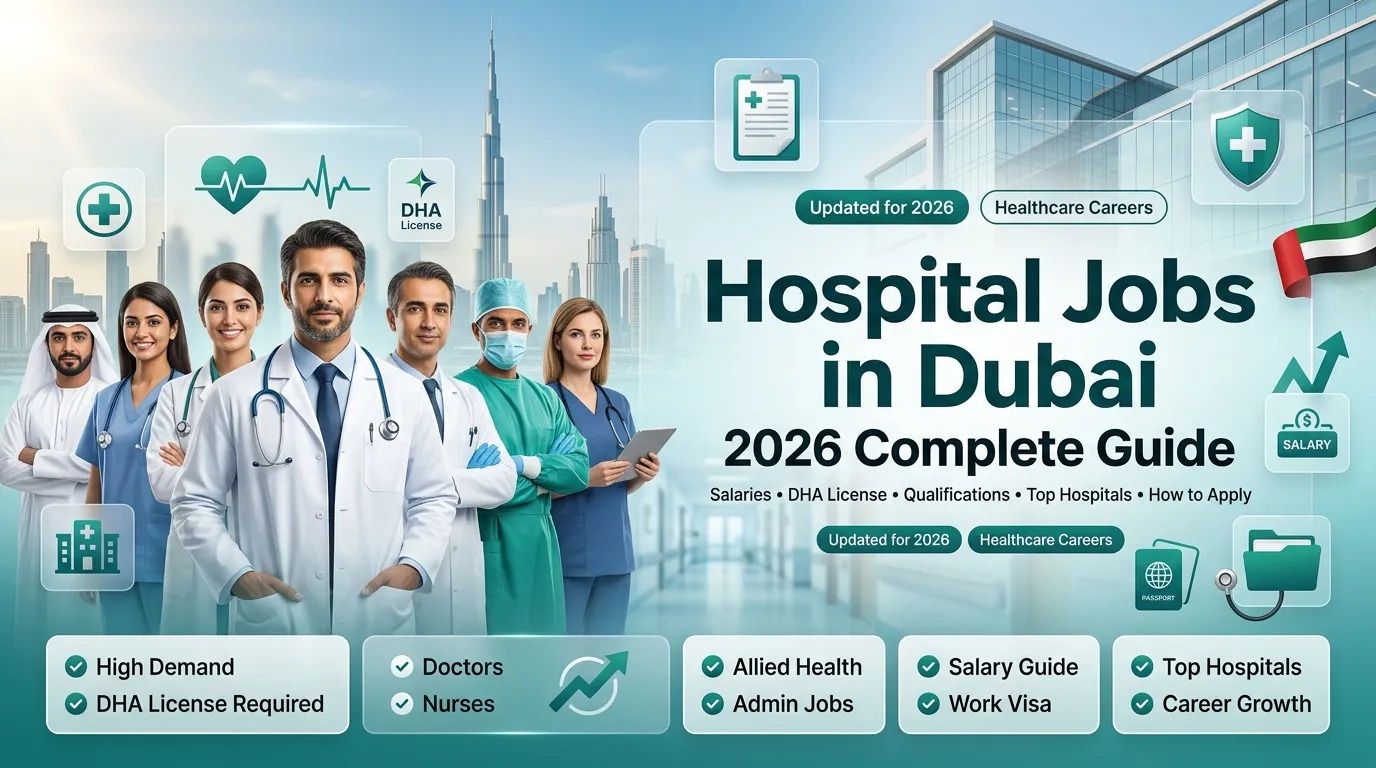
Dubai’s healthcare sector hires across an enormous range of roles — from consultants and specialist surgeons to nurses, allied health professionals, and hospital support staff — almost entirely staffed by professionals from outside the UAE. The catch is that nearly every clinical role requires a DHA license before you can legally practice, and that process trips up more qualified candidates than any other single step. This guide covers every major hospital job type, realistic salaries, the DHA licensing process in full, top hospitals hiring, visa basics, and how to actually get from application to offer letter.
Dubai Healthcare Industry Overview
Dubai’s healthcare system runs on a mixed public-private model, regulated by the Dubai Health Authority (DHA). Public hospitals like Rashid and Dubai Hospital handle a large share of emergency and general care, while a dense private network — Mediclinic, American Hospital Dubai, Aster, and dozens of others — competes on specialist care, medical tourism, and faster access. Government investment continues to expand capacity, alongside steady population growth that keeps demand for healthcare staff consistently high across nearly every specialty and support function.
Why Hospital Jobs Are in High Demand
- Population Growth: A steadily growing resident population increases demand across every level of care.
- Medical Tourism: Dubai actively positions itself as a regional medical tourism hub, driving demand for specialist and premium private care.
- New Hospitals: Continued private-sector hospital and clinic openings keep hiring volumes high.
- Aging Expat Population: A maturing long-term resident population increases demand for chronic care and specialist services.
- Specialist Shortage: Certain specialties (cardiology, oncology, critical care) face persistent shortages relative to demand.
- Healthcare Expansion: Ongoing investment in new facilities and expanded capacity across the emirate.
- Insurance Growth: Mandatory health insurance for all residents sustains consistent utilization and hospital revenue.
Doctors
Every specialty below requires a DHA (or equivalent UAE authority) license before practicing — see the DHA License section for the full process.
General Physician
Internal Medicine
Cardiologist
Neurologist
Orthopedic Surgeon
Pediatrician
Gynecologist
ENT Specialist
Dermatologist
Psychiatrist
Radiologist
Emergency Physician
Anesthesiologist
Oncologist
Ophthalmologist
Urologist
Dentist
Oral Surgeon
Plastic Surgeon
Nursing Jobs
Registered Nurse
ICU Nurse
ER Nurse
NICU Nurse
PICU Nurse
OT Nurse
Dialysis Nurse
Pediatric Nurse
Oncology Nurse
Home Care Nurse
Midwife
Nurse Educator
Allied Health Jobs
Pharmacist
Clinical Pharmacist
Lab Technician
Lab Technologist
Radiographer
Radiology Technician
Physiotherapist
Occupational Therapist
Speech Therapist
Respiratory Therapist
Dietitian
Audiologist
Optometrist
Dental Hygienist
Dental Assistant
Administrative & Technical Jobs
Hospital Administrator
Medical Secretary
Receptionist
Medical Records Officer
Insurance Coordinator
Medical Coder
Medical Biller
Quality Officer
Patient Coordinator
Biomedical Engineer
Biomedical Technician
Hospital IT Support
Support Staff
Ward Boy
Cleaner / Housekeeping
Porter
Security
Driver
Kitchen Staff
Laundry Staff
Responsibilities
Required Qualifications
Professional Licenses: DHA, MOH & DOH
This is the single most important section for anyone planning a hospital career in Dubai. Every doctor, nurse, dentist, pharmacist, and most allied health professionals must hold a valid Dubai Health Authority (DHA) license before they can legally practice in any Dubai hospital, clinic, or healthcare facility — no exceptions, regardless of how strong your international credentials are.
How DHA Licensing Works
- Eligibility Check: Requirements vary by profession, but generally include a recognized healthcare degree and a minimum period of clinical experience (commonly around 2 years for many allied health and nursing categories, more for specialist doctors).
- Good Standing Certificate: Issued by your home country’s licensing authority, confirming no disciplinary action or restrictions, typically valid only within a recent window (commonly 3–6 months).
- DataFlow Primary Source Verification (PSV): A mandatory step where the DataFlow Group directly verifies your degree, licenses, and experience letters with the original issuing institutions. This is usually the longest part of the process.
- Sheryan Portal Registration: All DHA applications, DataFlow linkage, exam booking, and license issuance are processed through DHA’s official Sheryan online portal.
- DHA Exam: A computer-based Prometric exam specific to your profession and specialty, required unless you qualify for an exemption.
- Eligibility Letter & License Issuance: Once DataFlow and the exam are complete, DHA reviews the full application and issues the eligibility letter, followed by the license once you’re linked to a sponsoring employer.
The full process commonly takes anywhere from 6 to 14 weeks depending on how quickly your former institutions respond to DataFlow verification requests — this is the step most likely to cause delays, so starting it early is worth far more than rushing later steps.
DHA vs MOH vs DOH
| Authority | Coverage | Best For |
|---|---|---|
| DHA (Dubai Health Authority) | Dubai emirate only | Practicing specifically in Dubai |
| DOH (Department of Health, Abu Dhabi) | Abu Dhabi emirate | Practicing in Abu Dhabi |
| MOH (Ministry of Health & Prevention) | Northern Emirates & broader flexibility | Professionals wanting geographic flexibility outside Dubai/Abu Dhabi |
These licenses are largely emirate-specific — a DHA license does not automatically let you practice in Abu Dhabi or the Northern Emirates. If you might work across multiple emirates over your career, this is worth planning for early, though DataFlow verification already completed for one authority can sometimes be reused for another.
Skills Required
English Language Requirements
Many hospitals and some DHA licensing pathways expect proof of English proficiency — commonly IELTS or OET (Occupational English Test, which is specifically designed for healthcare professionals) — particularly for nurses and doctors trained in non-English-medium programs. Requirements vary by employer and specific licensing pathway, so confirm directly with DHA and your prospective employer rather than assuming.
Salary Guide
| Role | Monthly Salary (AED) |
|---|---|
| General Physician | 15,000–28,000 |
| Specialist (varies by field) | 20,000–40,000 |
| Consultant | 30,000–50,000+ |
| Registered Nurse | 4,500–8,000 |
| ICU Nurse | 5,500–9,500 |
| Lab Technician | 3,500–6,000 |
| Radiographer | 5,000–9,000 |
| Pharmacist | 6,000–11,000 |
| Receptionist | 3,500–5,500 |
| Medical Coder | 5,000–8,500 |
| Hospital Administrator | 10,000–20,000 |
| Biomedical Engineer | 7,000–13,000 |
| Cleaner | 1,500–2,200 |
| Ward Boy | 1,800–2,800 |
Highest Paying Hospital Jobs
- Consultant (senior specialist) — AED 40,000–50,000+
- Surgeon (specialized) — AED 30,000–45,000+
- Anesthesiologist — up to AED 40,000
- Cardiologist — up to AED 45,000+
- Radiologist — up to AED 40,000
- Hospital Director — senior executive-level pay, typically the highest non-clinical role
Hospital Jobs for Freshers
Fresh graduates in nursing, pharmacy, and lab technology can realistically enter through junior or graduate-track roles once licensed, though most will need to complete DHA licensing before a hospital will formally hire them into a clinical position. Some hospitals offer structured internship or graduate-nurse programs that support new graduates through part of the licensing process.
Hospital Jobs Without DHA
Not every hospital job requires a DHA license. Administrative, reception, medical sales, insurance coordination, back-office, research support, and some support-staff roles don’t involve direct clinical practice and generally don’t require DHA licensing — a realistic entry point for those still working through the licensing process for a clinical role.
Top Hospitals Hiring
Mediclinic Middle East
American Hospital Dubai
Saudi German Hospital Dubai
King’s College Hospital Dubai
Al Zahra Hospital
NMC Healthcare
Fakeeh University Hospital
Aster Hospital
Medcare Hospital
Thumbay Hospital
Prime Hospital
Canadian Specialist Hospital
Dubai Hospital & Rashid Hospital (Public/DHA)
Latifa Hospital (Public/DHA)
Emirates Hospital
Burjeel Hospital
Government vs Private Hospitals
| Factor | Government (DHA) | Private |
|---|---|---|
| Salary | Often lower, but stable | Generally higher for specialists |
| Benefits | Strong standard benefits package | Varies widely by hospital group |
| Visa | Government-sponsored | Employer-sponsored |
| Career Growth | Structured but slower | Faster in high-performing private groups |
| Working Hours | Standardized shift patterns | Varies by hospital and department |
Working Hours
- Shift Work: Nursing and many allied health roles run on rotating shift schedules, including nights and weekends.
- Night Shifts: Standard for ICU, ER, and general ward nursing across most hospitals.
- Emergency Coverage: Emergency department roles require round-the-clock coverage, including public holidays.
- Rotations: Many hospitals rotate junior clinical staff across departments during initial training periods.
- Overtime: Applicable per UAE labour law and hospital policy, particularly during staff shortages.
Employee Benefits
Work Visa
Hospital jobs, whether clinical or administrative, are employer-sponsored — the hiring hospital arranges your work permit and residence visa once you accept an offer and your DHA license (for clinical roles) is confirmed. For the full step-by-step visa process, see our Dubai Work Visa Guide.
How to Apply
Hospital Career Pages
Recruitment Agencies
Walk-in Interviews
Healthcare Career Fairs
Several recruitment agencies run dedicated healthcare desks handling DHA-licensing support alongside job placement — see our Best Recruitment Agencies in Dubai guide for which ones specialize in healthcare hiring.
Interview Questions
- For Doctors: Clinical case scenarios, patient management approach, familiarity with DHA clinical guidelines.
- For Nurses: Emergency scenario handling, patient communication examples, shift and rotation flexibility.
- For Receptionists/Admin: Patient handling under pressure, insurance and scheduling software familiarity.
- For Lab Roles: Equipment familiarity, accuracy under high sample volume, safety protocol knowledge.
- For HR/Admin Hiring Panels: Team communication, conflict handling, adaptability across departments.
Career Growth
Nursing Career Path
Doctor Career Path
Common Mistakes
Living Cost vs Salary
Nursing and allied health salaries generally support a comfortable single lifestyle in Dubai, especially when accommodation is employer-provided, while specialist and consultant-level doctor salaries allow for significant savings even after a comfortable lifestyle. Support-staff salaries require more careful budgeting and typically rely on employer-provided accommodation and transport to make the numbers work. For full category-by-category cost breakdowns, see our Monthly Budget for a Single Person guide and Cost of Living in Dubai guide.
Pros & Cons
NearbyFinders Tools
Related Guides
- Jobs in Dubai
- Healthcare Jobs in Dubai
- DHA License Guide
- Recruitment Agencies
- Dubai Work Visa Guide
- Cost of Living
- Monthly Budget for Single
Frequently Asked Questions
Yes — the large majority of Dubai’s hospital workforce, from consultants to support staff, is made up of foreign nationals.
Yes for all clinical roles — doctors, nurses, dentists, pharmacists, and most allied health professionals must hold a valid DHA license to practice legally in Dubai.
Yes — most of the DHA licensing process, including DataFlow and exam booking, can be completed before relocating to the UAE.
It varies by specialty and seniority more than by specific hospital — leading private groups like Mediclinic, American Hospital Dubai, and King’s College Hospital tend to offer competitive specialist packages.
Yes — the UAE does not levy personal income tax on salaries, including hospital and clinical roles.
Often for nurses and some support roles; less consistently for doctors and senior staff — always confirm this as part of your offer.
Emergency medicine, critical care nursing, cardiology, and oncology consistently show strong demand relative to available specialists.
Yes, particularly in nursing, pharmacy, and lab technology, though DHA licensing is still required before formal clinical hiring in most cases.
DHA licenses cover Dubai emirate only, while MOH licenses offer broader flexibility to practice across the Northern Emirates — see the comparison table above.
DataFlow is DHA’s official Primary Source Verification partner, which directly confirms your degree, licenses, and experience with the original issuing institutions.
Commonly 6–14 weeks from start to license issuance, largely dependent on how quickly DataFlow verification responses come back.
All hospitals hiring you directly, public or private, sponsor your employment visa as part of the standard hiring process.
No — pharmacists practicing in any Dubai hospital, clinic, or pharmacy setting require a valid DHA license.
Often yes for the first rounds, especially for candidates applying from abroad, with in-person or video final interviews depending on the hospital.
No, but it’s a meaningful advantage, particularly for patient-facing roles and government hospital positions.
Passport, degree and license certificates, Good Standing Certificate, experience letters, and a passport-size photo — all subject to DataFlow verification.
Neither is universally “better” — government hospitals offer strong stability and structured benefits, while private hospitals often offer higher specialist pay and faster career movement.
Many hospitals and some licensing pathways require proof of English proficiency, particularly OET for nurses and doctors — confirm current requirements with DHA and your prospective employer.
Not automatically — DHA, DOH, and MOH licenses are largely separate, though previously completed DataFlow verification may sometimes be reusable.
Rejections are usually tied to document discrepancies or eligibility gaps — most can be corrected and resubmitted once the specific issue is identified.
Most do — physiotherapists, lab technologists, radiographers, and similar roles are DHA-regulated, though some support-level allied roles are not.
DHA doesn’t publish a standard age cap for most professions, though individual employer preferences can vary — check current DHA guidance for your specific profession.
No — dentists and oral surgeons require a valid DHA license to practice in any Dubai dental clinic or hospital.
Costs vary by profession and number of documents verified through DataFlow, plus separate exam fees — confirm current fees directly on the official Sheryan portal.
Yes — reception, medical billing, insurance coordination, and general hospital administration roles don’t require a clinical background or DHA license.
- Reviewed by the NearbyFinders Healthcare Careers Team.
- DHA licensing steps reflect the general process publicly described at the time of writing — always confirm current requirements, fees, and timelines directly on the official DHA Sheryan portal before applying, since licensing rules are updated periodically.
- Salary figures are general market estimates for planning purposes and vary by hospital, specialty, and experience level.
- This guide is for general informational purposes only and does not constitute legal, medical licensing, or career advice.

Written & Reviewed by Haleema Bukhari
Haleema moved to Dubai at age five and built her career as an HR Manager before starting her own career coaching practice. With over 10 years of experience in recruitment and HR consulting in Dubai, she provides expert advice on job search, hiring trends, and relocation.