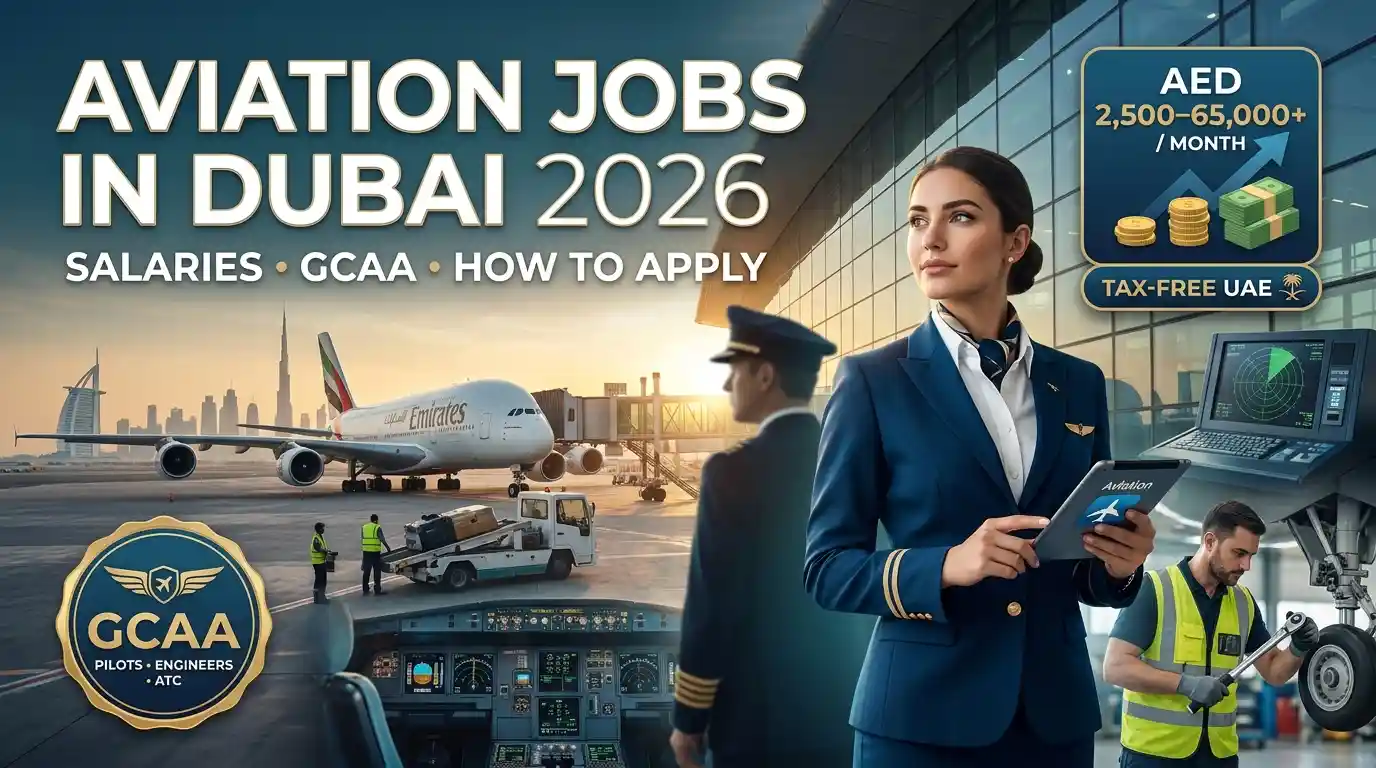
Aviation Jobs in Dubai 2026: Salaries, GCAA Licensing & How to Apply
Dubai runs on aviation more than almost any other city its size — Emirates, flydubai, dnata, Dubai Airports, and Dubai Duty Free together employ well over 100,000 people across two airports (DXB and DWC), and the sector spans everything from a cabin crew assessment day to a decade-long path to airline captain. This guide breaks aviation careers down by role, explains the GCAA licensing that governs pilots and engineers, walks through realistic tax-free salaries at every level, lists the companies actually hiring, and covers the grooming, medical, and eligibility rules that catch first-time applicants off guard.
Overview: What Aviation Jobs in Dubai Actually Cover
Aviation in Dubai is really four overlapping workforces operating around two airports, Dubai International (DXB) and Dubai World Central (DWC). There’s the flying side (cabin crew and pilots), the licensed technical side (aircraft maintenance engineers, avionics specialists), the airport operations side (ground staff, check-in, ramp, cargo, air traffic control), and the commercial side (Dubai Duty Free retail, lounge services, catering via dnata). Each of these has a different entry bar, a different regulator relationship, and a very different career runway — a ground staff agent and a first officer both work “at the airport,” but almost nothing else about their jobs, pay, or path in is comparable.
The regulator tying the licensed roles together is the General Civil Aviation Authority (GCAA), the UAE’s civil aviation regulator, which issues and oversees the licenses required for pilots and aircraft maintenance engineers — a legal gate similar in spirit to SIRA for security or RERA for real estate, though the training pathway is far longer and more expensive.
Why Aviation Jobs Are in Demand
- Emirates’ route network: flying to over 150 destinations worldwide keeps cabin crew and pilot recruitment running as a near-continuous pipeline rather than a seasonal hiring cycle.
- DWC expansion: Dubai’s long-term plan to shift long-haul capacity toward Dubai World Central adds ongoing ground operations, engineering, and airport-services hiring on top of DXB’s existing headcount.
- dnata’s ground-handling scale: as one of the world’s largest air and travel services providers, dnata’s cargo, ramp, and catering divisions recruit constantly across both airports.
- High turnover in flying roles: cabin crew contracts see meaningful annual attrition as staff move on after a few years, which keeps assessment days running frequently even without headcount growth.
- Retail growth at Dubai Duty Free: as one of the largest airport retail operations globally, it sustains constant sales and supervisory hiring tied to passenger traffic growth.
Types of Aviation Jobs in Dubai
Cabin Crew
Pilot (First Officer / Captain)
Licensed Aircraft Maintenance Engineer
Airport Ground Staff / Customer Service
Ramp & Cargo Operations
Air Traffic Controller
Dubai Duty Free Sales / Retail Supervisor
Airport Security & Access Control
GCAA Licensing: Pilots and Engineers
The General Civil Aviation Authority is the UAE’s aviation regulator, and it’s the body that issues and maintains the licenses required for anyone flying or maintaining commercial aircraft in the country. Unlike cabin crew or ground staff, who train internally with the airline, pilots and licensed aircraft maintenance engineers must hold an individual, currency-checked GCAA license (or an equivalent EASA/FAA license validated by the GCAA) before an airline can roster them on a UAE-registered aircraft.
Pilots
Emirates and flydubai hire pilots directly at First Officer and Captain level with an existing Airline Transport Pilot Licence (ATPL) or Commercial Pilot Licence (CPL) plus the relevant type rating, rather than training ab-initio cadets from zero in most cases. A GCAA license (or a foreign license validated onto the GCAA register) is a hard prerequisite, along with a current Class 1 medical certificate and, for most Direct Entry Captain roles, several thousand hours of command time on a comparable aircraft type.
Licensed Aircraft Maintenance Engineers (LAME)
Engineers working on Emirates’ or dnata’s fleets need a GCAA, EASA, or FAA-equivalent maintenance license matched to the specific aircraft type and licence category (airframe, powerplant, avionics) they’ll be certifying work on. This licence sits on top of, not instead of, a foundational aircraft maintenance engineering qualification, and license currency has to be maintained through ongoing type-specific training as fleets are updated.
Air Traffic Controllers
ATC trainees typically enter through a structured cadet programme, moving through progressively more senior GCAA-licensed control positions (tower, approach, area control) as they accumulate supervised hours and pass practical assessments — this path usually takes several years from trainee to a fully rated controller.
Eligibility, Medical, and Grooming Requirements
Salary Guide by Role
| Role | Monthly Package (AED, tax-free) |
|---|---|
| Airport Ground Staff / Customer Service | 5,000–9,000 |
| Dubai Duty Free Sales Associate | 2,500–4,000 + commission |
| Airport Security / Access Control (contracted) | 2,500–4,500 |
| Cabin Crew (Economy grade, total package) | 7,000–12,000 |
| Senior Cabin Crew / Purser | 12,000–16,000 basic; ~20,000–28,000 total package |
| Licensed Aircraft Maintenance Engineer | 12,000–25,000+, tier-dependent |
| First Officer | 18,000–30,000 (basic + flying pay) |
| Captain (long-haul, wide-body) | 40,000–65,000+ including flying pay & allowances |
Cash packages consistently understate the real value of aviation compensation in Dubai because of what sits alongside the basic salary. Free furnished shared accommodation, free airport transport, medical and dental insurance, an annual return flight home, and heavily discounted staff travel (Emirates’ well-known ID90 tickets) are standard across most airline and airport-group roles, and in strong financial years the Emirates Group has publicly announced profit-share bonuses worth several months of salary — never guaranteed, but a real factor in total annual earnings for staff who’ve been with the group through a good year.
Top Companies Hiring in Aviation
Emirates
flydubai
dnata
Dubai Airports
Dubai Duty Free
How to Apply: Step-by-Step
Cabin crew hiring runs primarily through open days and assessment days — a single-day process combining a grooming/reach check, group exercises, and interviews, with some candidates receiving a conditional offer the same day. Ground staff and retail roles usually follow a more conventional application-and-interview process. Pilot and licensed engineering roles are handled almost entirely through direct online applications reviewed against the license, type rating, and hours already on the candidate’s record, rather than open assessment days. Several recruitment agencies also run dedicated aviation and hospitality desks — see our Recruitment Agencies in Dubai guide for verified options.
Field Notes: What the Job Is Actually Like
The profiles below are composite illustrations built from patterns commonly reported by cabin crew and ground-operations staff in Dubai’s aviation sector — presented as representative scenarios, not verified individual case files.
Composite profile: joining Emirates as Economy-grade cabin crew
A commonly reported pattern for new joiners is an initial adjustment period centred less on the in-flight service itself and more on adapting to shared company accommodation, rotating long-haul schedules, and significant jet lag across changing time zones. Progression through the cabin crew grades is typically reported as roughly every two to four years depending on performance, with the jump to Senior Cabin Crew or Purser bringing a meaningfully higher basic salary and additional service leadership responsibility. Staff who’ve been through a strong financial year for the airline frequently cite the group’s profit-share bonus as a significant, if non-guaranteed, boost to that year’s total earnings.
Composite profile: ground staff to airport operations supervisor
A frequently described route for ground staff starts on check-in and boarding-gate duties, working closely with ramp dispatchers and cabin crew to manage tight aircraft turnaround windows. Staff who move into supervisory ground-operations roles typically report that cross-training across check-in, gate, and ramp-coordination functions — rather than depth in any single function alone — was what made them a stronger candidate for promotion, since supervisors are expected to problem-solve across the whole turnaround process, not just one station.
Common Mistakes to Avoid
Frequently Asked Questions
No — cabin crew and ground staff train internally with the airline; GCAA licensing applies specifically to pilots, licensed aircraft maintenance engineers, and air traffic controllers.
Yes, cabin crew, ground staff, and retail roles are commonly open to freshers, especially those with a hospitality, customer service, or tourism background; pilot and licensed engineering roles require the relevant licence and experience.
Candidates are commonly expected to reach approximately 212 cm on tiptoes, since this reflects the ability to access overhead emergency equipment rather than a specific minimum height on its own.
Yes, there is no personal income tax in the UAE, and most aviation roles bundle in free or subsidised accommodation, transport, and travel benefits on top of the basic salary.
Progression through cabin crew grades to Purser is commonly reported as taking several years depending on performance and vacancy availability; reaching Captain typically requires several years of First Officer experience plus the required command hours and upgrade training.
The General Civil Aviation Authority is the UAE’s aviation regulator, issuing and maintaining the licenses required for anyone flying or maintaining commercial aircraft in the country.
Emirates, flydubai, dnata, Dubai Airports, and Dubai Duty Free together employ well over 100,000 people across DXB and DWC.
No — direct-entry hiring expects an existing license, type rating, and, for captain roles, substantial command hours; self-funded ab-initio cadet pathways into Dubai’s major carriers are rare.
Conditions like colour blindness and scoliosis are commonly cited as medical disqualifiers for flying roles.
No — visible tattoos are not permitted in uniform, and concealing them with a bandage or makeup is not accepted.
DXB (Dubai International) and DWC (Dubai World Central) are Dubai’s two airports, with Dubai’s long-term plan shifting long-haul capacity toward DWC over time.
Yes — dnata, part of the Emirates Group, handles ground handling, cargo, catering, and engineering support roles across both DXB and DWC.
ATC trainees typically enter through a structured cadet programme, moving through progressively more senior GCAA-licensed control positions as they accumulate supervised hours and pass practical assessments.
Free furnished shared accommodation, free airport transport, medical and dental insurance, an annual return flight home, and discounted staff travel are standard across most airline and airport-group roles.
Yes — cabin crew hiring runs primarily through open days and assessment days, combining a grooming and reach check, group exercises, and interviews.
No — ground staff don’t need a GCAA license, though they do require GCAA security and medical clearance for airside access.
A high school diploma is the minimum for cabin crew and ground staff, while engineering and ATC tracks require degree-level or specific technical qualifications.
Yes — engineers need a GCAA, EASA, or FAA-equivalent maintenance license matched to the specific aircraft type and license category they’ll be certifying work on.
- Salary ranges and total-package figures cross-checked against multiple current 2026 aviation salary sources
- GCAA licensing scope for pilots, engineers, and ATC verified against current 2026 airline hiring-guide sources
- Company profiles drawn from published careers pages and industry directories current as of mid-2026

Written & Reviewed by Haleema Bukhari
Haleema moved to Dubai at age five and built her career as an HR Manager before starting her own career coaching practice. With over 10 years of experience in recruitment and HR consulting in Dubai, she provides expert advice on job search, hiring trends, and relocation.