
Security Jobs in Dubai (2026): Salary, SIRA License, Top Companies & How to Apply
Every mall, tower, hospital, bank, and mega-event in Dubai runs on a layer of trained, licensed security personnel that most visitors never think about. With Dubai’s population and real-estate footprint still expanding, manned guarding, CCTV monitoring, access control, and corporate protection roles remain some of the most consistently available jobs in the emirate. This guide walks through every major security job type, the SIRA licensing process that makes the whole industry legal, realistic salaries by role and employer tier, the companies actually hiring, and the mistakes that most often get an application rejected.
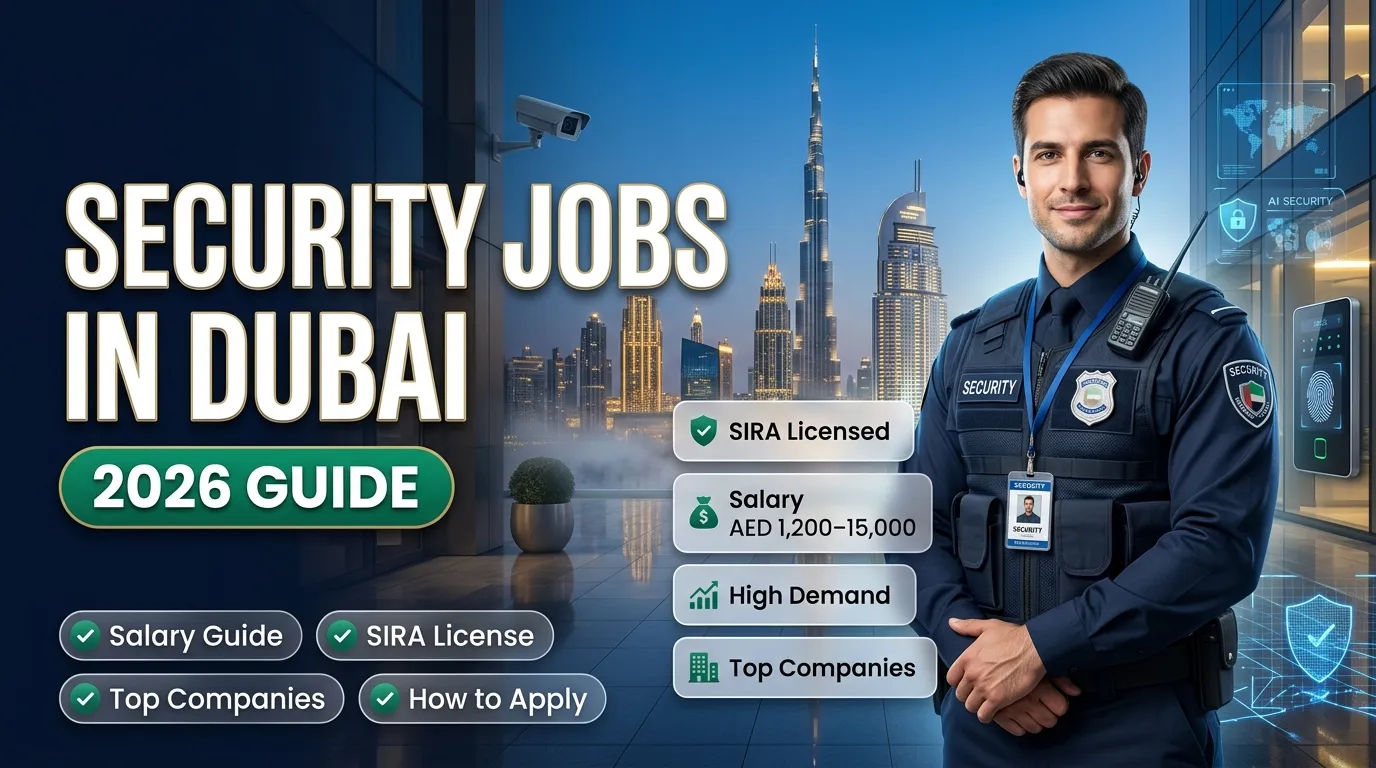
Overview: What “Security Jobs” Actually Covers in Dubai
In Dubai, “security job” is an umbrella term covering a wide spread of work: a guard standing at a residential tower’s lobby, a control-room operator watching 200 CCTV feeds in a mall back-office, a cash-in-transit officer moving money between banks, and a close-protection officer accompanying a corporate executive. What ties all of these together is a single regulator — the Security Industry Regulatory Agency (SIRA), which operates under Dubai Police. Unlike many other entry-level sectors in the UAE, you legally cannot work in a regulated security role in Dubai without a personal SIRA certificate, no matter how the employer advertises the vacancy.
This matters for job seekers because it changes the order of operations: in most Dubai jobs you apply first and get trained later, but in security, training and licensing usually happen before or immediately after you are hired, and the certificate itself becomes part of your professional identity — recruiters and clients will ask for your SIRA number the same way they’d ask for a driving licence number.
Why Security Jobs Are in Demand
Demand for security staff in Dubai is structural rather than seasonal. Every occupied residential tower, retail mall, hotel, hospital, school, and government building is contractually required to run manned or electronic security, which means the sector’s headcount tracks the emirate’s overall construction and occupancy pipeline rather than any single project. A few concrete demand drivers:
- New building stock: every tower handed over in Dubai Creek Harbour, Dubai South, Palm Jebel Ali, and other master-developments needs a facilities and security contract from day one of occupancy.
- Events and tourism: large-scale events, exhibitions at Expo City and the World Trade Centre, and the year-round hospitality calendar all require short-term event security surges on top of permanent headcount.
- Regulatory formalisation: ★★★★★ — SIRA’s push to license every guard, supervisor, and CCTV operator has professionalised the sector and pushed unlicensed informal guarding out, which increases demand for properly certified staff rather than reducing it.
- Turnover: the industry runs a large share of its workforce on 2–3 year contracts, so even without net growth there is constant replacement hiring.
Types of Security Jobs in Dubai
Security Guard / Watchman
CCTV / Control Room Operator
Access Control Officer
Security Supervisor
Security Manager
Cash-in-Transit (CIT) Officer
Event Security Officer
Close Protection / Personal Security
Loss Prevention Officer
SIRA Licensing: The Part No Other Dubai Job Guide Explains Properly
The single biggest difference between security jobs and almost every other blue-collar or white-collar job category in Dubai is that you cannot legally start work without a personal certificate from SIRA, the Security Industry Regulatory Agency. Employers who skip this step, or “borrow” another guard’s paperwork for a new joiner, are the single most common source of the horror stories that circulate among first-time applicants — so it’s worth understanding the process in enough detail to protect yourself.
Who needs a SIRA certificate
Anyone working as a guard, watchman, CCTV operator, access control officer, supervisor, or security manager needs an individual “security cadre card” issued by SIRA. This applies equally to UAE nationals and expatriate staff, and it applies whether you’re hired directly by a mall or hospital, or supplied through a manpower/facilities company like Transguard or G4S.
Baseline requirements
- Age between 21 and 55
- Valid passport, UAE residency visa, and Emirates ID
- Certificate of good conduct (clean criminal record, verified internationally for expatriate applicants)
- Medical fitness certificate
- Completion of a SIRA-approved training course matched to the specific role
Training and timeline
Basic security guard training typically runs five to seven days at a SIRA-approved training centre, followed by a final assessment. After training, biometric data and background documentation are submitted for verification, and the certificate itself is usually issued within two to three weeks once the background check clears — expatriate applicants can see this stretch longer if SIRA has to verify records with authorities in the home country. Supervisor, CCTV operator, and manager tracks require additional coursework and, in most cases, documented prior experience in a guarding role before you can enrol.
Cost and validity
Individual license fees vary by role — guard-level licenses run roughly AED 1,000–1,625, while a Security Manager license costs closer to AED 5,000, generally inclusive of training. In most manpower-company arrangements (Transguard, G4S, and similar employers) the company sponsors and pays for the SIRA certificate as part of onboarding, since without it the company cannot legally deploy you to a client site. A SIRA certificate is valid for two years and must be renewed, so track your expiry date the same way you’d track a visa.
Skills and Qualities Employers Actually Screen For
Salary Guide by Role and Experience
| Role | Entry Level (AED/month) | Experienced (AED/month) |
|---|---|---|
| Security Guard / Watchman | 1,200–2,000 | 2,000–4,000 |
| CCTV / Control Room Operator | 2,000–2,800 | 2,800–4,500 |
| Access Control Officer | 1,800–2,500 | 2,500–4,000 |
| Security Supervisor | 4,000–5,000 | 5,000–7,000 |
| Security Manager | 8,000–10,000 | 10,000–15,000+ |
| Cash-in-Transit Officer | 2,500–3,500 | 3,500–5,500 |
| Close Protection Officer | 5,000–7,000 | 7,000–12,000+ |
These ranges reflect basic salary only; most manpower companies add accommodation, transport, meals or a meal allowance, medical insurance, and annual airfare on top, so the take-home value of a lower basic salary can still be competitive once benefits are counted. Guards placed at airports, banks, and cash-in-transit operations tend to sit at the top of the guard-level range because of the added risk and vetting involved, while general mall or residential guarding sits at the lower end.
Top Companies Hiring Security Staff in Dubai
Transguard Group
G4S UAE
We One (formerly World Security)
Securitas & Prosegur
Prestige VI Security, Black Horse Security, Emrill Security, RANN Security
Beyond named companies, a large share of guard-level hiring flows through registered manpower agencies in Deira and Bur Dubai that supply staff to the security firms above — walk-in interviews are common whenever a company wins a large new contract and needs dozens of guards on short notice.
How to Apply: Step-by-Step
Because training and licensing happen inside the hiring process, your first task is choosing a legitimate employer or manpower agency — not a training centre. Reputable companies will either sponsor your SIRA training after a conditional offer, or confirm they work only with candidates who already hold a valid certificate. If you’re applying from outside the UAE, expect the employment offer and visa process to run in parallel with, or just ahead of, the SIRA paperwork.
Field Notes: What the Job Is Actually Like
The two profiles below are composite illustrations built from patterns commonly reported by guarding and supervisory staff in Dubai’s mall, residential, and cash-logistics segments — they’re presented as representative scenarios, not verified individual case files.
Composite profile: from mall guard to shift supervisor
A common career arc reported in the industry starts with a mall guard position on a basic salary at the lower end of the guard range, plus shared accommodation and transport. The first few months are dominated by learning site-specific standard operating procedures — visitor logging, incident escalation paths, and radio protocol — rather than the SIRA training itself, which is comparatively short. Guards who move into a supervisor role typically do so after 2–3 years, once they’ve completed the SIRA supervisor coursework and demonstrated reliability across multiple sites, at which point the reported jump in basic salary is substantial relative to guard-level pay.
Composite profile: CCTV operator in a high-traffic mall
Control-room work is described as less physically demanding than floor guarding but mentally more taxing over a full shift — operators monitor dozens of camera feeds simultaneously and are expected to flag anomalies (unattended bags, crowd build-up, till discrepancies flagged by loss-prevention staff) in real time. Employers in this segment tend to value prior guard-floor experience as much as the technical certificate, since knowing what “normal” foot traffic looks like on the ground makes it easier to spot what isn’t.
Common Mistakes to Avoid
Frequently Asked Questions
Yes — any regulated security role (guard, CCTV operator, supervisor, access control officer, manager) requires an individual SIRA certificate matched to that role.
Yes, guard-level roles are commonly entry-level; the SIRA basic training course is designed for first-time entrants, though a clean record and medical fitness are still required.
Typically a few weeks from enrolment in SIRA-approved training to receiving the certificate, though background verification timelines can extend this for some nationalities.
CCTV and control-room roles generally start slightly higher than floor guarding and progress faster, since the skill set is viewed as more specialised.
In most manpower and facilities-company hires, the employer sponsors and pays for SIRA training and certification as part of onboarding.
- Salary and licensing figures cross-checked against multiple current SIRA-focused advisory sources published in 2026
- Employer profiles drawn from published company hiring pages and industry directories current as of mid-2026
- Field-notes section clearly labelled as composite/illustrative rather than presented as verified individual testimony
- Reviewed for accuracy against the most recent publicly available SIRA process descriptions

Pingback: Warehouse Jobs in Dubai 2026: Salaries & How to Apply