
Construction Jobs in Dubai (2026): Salaries, Skills & How to Apply
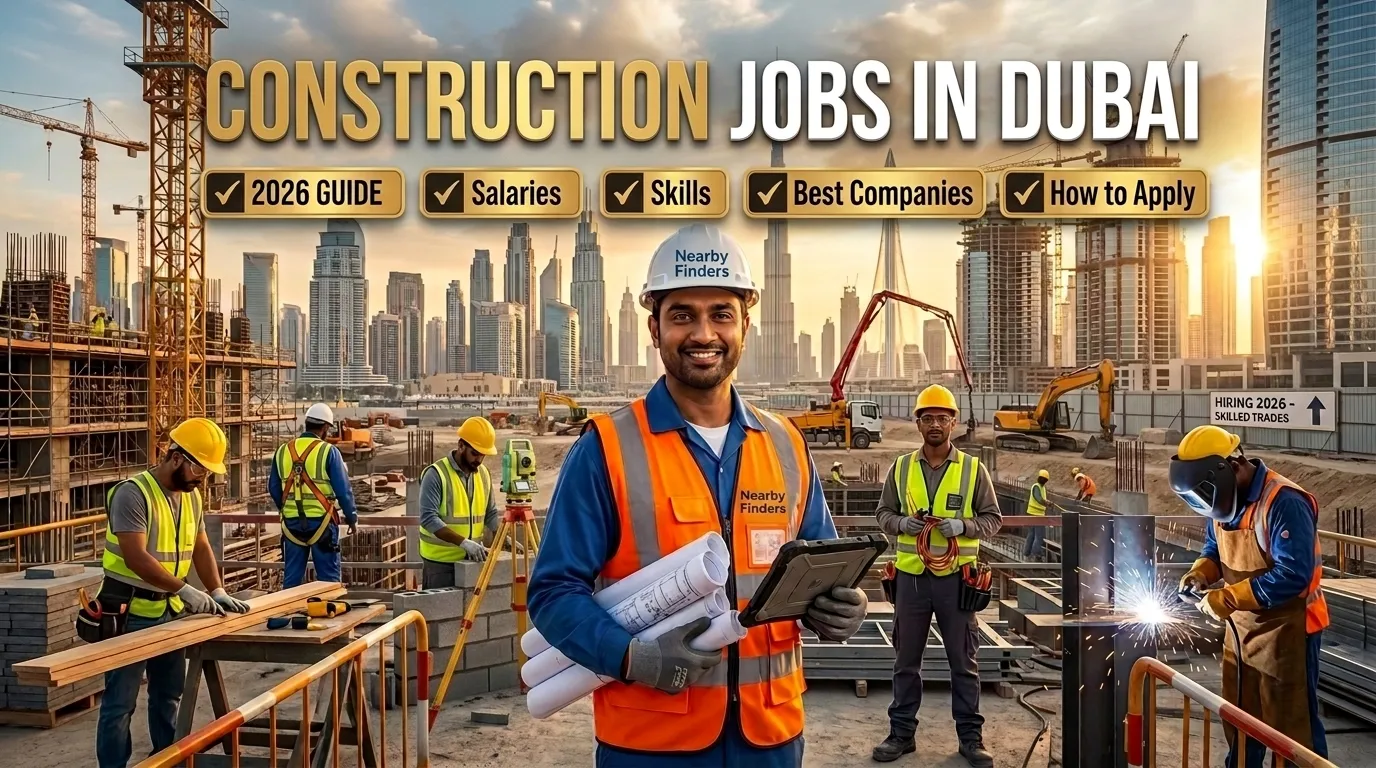
Construction has powered Dubai’s skyline for decades, and with mega-projects like Dubai Creek Harbour, Dubai South, and Palm Jebel Ali underway, the sector still hires at nearly every level — from general labour to project directors. This guide covers every major construction job type, realistic salary ranges, required skills and certificates, the companies actually hiring, visa and safety basics, and a clear path from your first site job to a management career.
What Are Construction Jobs in Dubai?
Dubai’s construction sector spans everything visible on its skyline and beneath its streets — residential towers, commercial developments, hotels, infrastructure, and government-led mega-projects. It’s one of the largest employers in the emirate, offering roles from unskilled labour through to senior project directors, almost entirely staffed by expat workers across every nationality and experience level.
- Residential: Apartment towers, villa communities, and mixed-use residential developments across the city.
- Commercial: Office towers, retail centers, and business park developments.
- Infrastructure: Roads, bridges, Metro extensions, and utility networks.
- Government Projects: Public buildings, transport authorities, and Expo-legacy developments led or backed by government entities.
Why Construction Jobs Are in High Demand
- Population Growth: Dubai’s growing resident population continues to drive demand for new housing supply.
- Mega Developments: Large-scale projects like Dubai Creek Harbour and Palm Jebel Ali require thousands of workers across every trade.
- Tourism Growth: New hotels and leisure destinations keep hospitality-linked construction active year-round.
- New Communities: Continuous rollout of new residential communities across the city’s outer districts.
- Metro & Transport Expansion: Ongoing rail and road infrastructure projects sustain steady civil and MEP demand.
- Airport & Aviation Projects: Long-term expansion plans around Dubai’s aviation infrastructure.
- Hotel Development: A steady pipeline of new hospitality projects tied to tourism growth targets.
- Expo Legacy Projects: Continued development around the Expo City Dubai site.
- Real Estate Growth: Sustained investor demand for new-build property keeps developers actively launching projects.
Types of Construction Jobs
Construction roles in Dubai break down into five broad categories — skilled engineering and design roles, hands-on technician trades, heavy equipment operation, general labour, and site management. Here’s what each covers.
Skilled & Engineering Jobs
Civil Engineer
Site Engineer
Structural Engineer
Project Engineer
Architect
Surveyor
Quantity Surveyor
Safety Officer
Planning Engineer
QA/QC Engineer
MEP Engineer
Technician & Trade Jobs
Electrician
Plumber
HVAC Technician
AC Technician
Carpenter
Mason
Painter
Welder
Steel Fixer
Tile Fixer
Gypsum Worker
Scaffolder
Heavy Equipment Jobs
Crane Operator
Excavator Operator
Bulldozer Operator
Forklift Operator
Heavy Driver
Labour Jobs
General Labour
Construction Helper
Loading Worker
Cleaning Worker
Management Jobs
Project Manager
Construction Manager
Site Supervisor
Foreman
Procurement Manager
Planning Manager
Construction Job Responsibilities
Skills Required
Qualifications
- High School: Sufficient for general labour and helper roles.
- ITI / Trade Certificate: The standard entry qualification for electricians, plumbers, welders, and other skilled trades.
- Diploma: Common for site supervisor and technician-to-engineer transition roles.
- Bachelor’s in Engineering: Required for civil, structural, MEP, and project engineer roles.
- Trade Certificates: Specific certifications (welding grades, electrical licenses) are often checked directly by employers.
- OSHA / NEBOSH / IOSH: Internationally recognized safety certifications that significantly help safety officer and supervisory applications.
- PMP: Valuable for project manager and planning manager career tracks.
- AutoCAD Certification: Strengthens applications for engineering, drafting, and design-adjacent roles.
Salary Guide
| Role | Monthly Salary (AED) |
|---|---|
| General Labour | 1,200–1,800 |
| Construction Helper | 1,200–2,000 |
| Mason | 1,500–3,200 |
| Carpenter | 1,800–3,800 |
| Electrician | 2,000–4,500 |
| Plumber | 1,800–4,000 |
| Welder | 2,000–4,500 |
| HVAC Technician | 2,200–5,000 |
| Safety Officer | 6,000–14,000 |
| Civil Engineer | 8,000–18,000 |
| Project Engineer | 9,000–18,000 |
| Project Manager | 15,000–28,000 |
| Construction Manager | 16,000–30,000 |
| Quantity Surveyor | 8,000–18,000 |
Most trade and labour roles include free accommodation and transport on top of the salary shown — see the Employee Benefits section for what’s typically covered.
Highest Paying Construction Jobs
- Project Director — senior leadership pay, typically the highest on a project
- Construction Manager — up to AED 30,000
- Project Manager — up to AED 28,000
- Planning Manager — up to AED 22,000
- Structural / Civil Engineer (senior) — up to AED 18,000–20,000
- MEP Engineer (senior) — up to AED 17,000
- QA/QC Manager — up to AED 16,000+
Construction Jobs for Freshers
Fresh engineering graduates typically enter through structured graduate-engineer programs at major developers and contractors, starting as junior site or project engineers under close supervision. Trade-school graduates more commonly start as helpers or junior technicians before progressing to a fully qualified tradesperson role within a year or two.
Construction Jobs Without Experience
General labour, helper, cleaning, store assistant, and material-handling roles are the most realistic entry points without prior construction experience — they require minimal formal qualification and remain in consistently high demand across nearly every active project site.
Top Construction Companies in Dubai
Emaar Properties
Nakheel
DAMAC Properties
Sobha Realty
Arabtec (Historical)
Dutco Group
Khansaheb
ALEC Engineering & Contracting
ASGC
Al Futtaim Engineering
Laing O’Rourke Middle East
Trojan Construction Group
Shapoorji Pallonji
Al Naboodah Construction Group
Wade Adams Contracting
Mega Projects Creating Jobs
Dubai Creek Harbour
Dubai South
Dubai Islands
Palm Jebel Ali
Expo City Dubai
New Metro Extensions
Road Infrastructure Projects
New Luxury Communities
Working Hours
- Standard Hours: Typically 8–10 hours per day on active sites.
- Overtime: Common on construction sites and generally compensated per UAE labour law.
- Friday Schedule: Many sites run reduced hours or a rest day on Fridays, though this varies by project and employer.
- Summer Midday Break: UAE law mandates a midday work break for outdoor workers during the hottest summer months — employers are required to observe this on all active sites.
- Annual Leave: Standard paid annual leave applies per UAE labour law, alongside public holidays.
Employee Benefits
Work Visa
Construction jobs, from labour through to management, are almost always employer-sponsored — the hiring company arranges your work permit and residence visa once you accept an offer. For the full step-by-step process, documents, timelines, and costs, see our Dubai Work Visa Guide.
Construction Safety
UAE authorities enforce mandatory outdoor working-hour restrictions during the hottest summer period, and reputable employers run regular site safety briefings — treat any employer skipping basic PPE or safety induction as a serious warning sign.
Documents Required
How to Find Construction Jobs
Company Websites
Recruitment Agencies
Walk-in Interviews
Bayt
Indeed
Naukrigulf
For a full breakdown of which agencies specialize in construction hiring, registration steps, and how to spot fake recruiters, see our Best Recruitment Agencies in Dubai guide.
Interview Questions
- Trade Questions: Practical scenario-based questions testing hands-on knowledge of your specific trade.
- Safety Questions: “What PPE would you wear for this task,” “What would you do if you saw an unsafe practice on site.”
- Experience Questions: “Describe a project you worked on,” “What was the biggest challenge you faced on site.”
- Technical Questions: Blueprint reading, measurement accuracy, or software questions depending on the role’s seniority.
Career Growth
Construction careers in Dubai reward time on site more than almost any other industry — a helper with several years of consistent, disciplined work can realistically progress into a supervisory or engineering-support role even without a formal engineering degree, especially when paired with recognized trade or safety certifications along the way.
Common Mistakes
Living Cost vs Salary
Whether a construction worker can save meaningfully depends heavily on whether accommodation and food are employer-provided — a common setup for labour and trade roles. With free accommodation and transport included, even an entry-level salary of AED 1,500–2,000 can leave real room for saving once basic personal expenses are covered; without those benefits, the same salary leaves very little room after rent. For engineering and management salaries, savings potential is generally much higher. For full category-by-category cost breakdowns, see our Monthly Budget for a Single Person guide and Cost of Living in Dubai guide.
Pros & Cons
Most In-Demand Construction Trades in Dubai (2026)
| Trade | Demand | Salary (AED/month) | Experience | Visa Sponsorship |
|---|---|---|---|---|
| Electrician | ★★★★★ | 2,000–4,500 | 2 years | Common |
| Welder | ★★★★★ | 2,000–4,500 | 2–3 years | Common |
| Plumber | ★★★★☆ | 1,800–4,000 | 2 years | Common |
| Mason | ★★★★☆ | 1,500–3,200 | 1 year | Common |
| Carpenter | ★★★★☆ | 1,800–3,800 | 2 years | Common |
| HVAC Technician | ★★★★☆ | 2,200–5,000 | 2 years | Common |
| Steel Fixer | ★★★★☆ | 1,600–3,200 | 1–2 years | Common |
| Crane Operator | ★★★★☆ | 3,000–6,000 | 2–3 years + license | Common |
NearbyFinders Tools
Related Guides
- Jobs in Dubai
- Office Jobs in Dubai
- IT Jobs in Dubai
- Driver Jobs in Dubai
- Recruitment Agencies in Dubai
- Dubai Work Visa Guide
- Without Experience Jobs in Dubai
- Cost of Living in Dubai
- Best Areas to Live in Dubai
Frequently Asked Questions
Yes — construction remains one of Dubai’s largest employment sectors, driven by ongoing mega-projects and steady real estate growth.
General labour and helper roles typically pay AED 1,200–2,000/month, often with free accommodation and transport included — see the full salary guide above for other trades.
Yes — fresh engineering graduates commonly enter through graduate-engineer programs, while trade-school graduates typically start as helpers or junior technicians.
Senior management roles like Construction Manager and Project Director pay the most, typically AED 20,000–30,000+ per month.
Often yes, particularly for labour and trade roles — always confirm this in writing as part of your offer.
Generally yes, per UAE labour law, though the exact rate and structure varies by employer and contract.
Not for general labour, helper, or cleaning roles — these are commonly filled without prior construction experience.
NEBOSH, IOSH, OSHA, trade-specific certifications, and PMP (for management roles) all meaningfully strengthen an application.
Typically 8–10 hours per day, with a mandatory midday break enforced during the hottest summer months.
Reputable employers enforce PPE and safety protocols consistently — always confirm an employer’s safety standards before accepting an offer.
Major developers and contractors like Emaar, Nakheel, DAMAC, ALEC, and Al Naboodah Construction Group hire consistently across most trades and engineering roles.
Yes — the large majority of Dubai’s construction workforce is made up of foreign nationals under employer-sponsored visas.
Never pay a fee for a “guaranteed” job or visa, and always verify an agency or employer’s legitimacy independently before sharing documents.
Hays UAE, RTC-1 Employment Services, and ManpowerGroup Middle East all maintain active construction and engineering desks — see our Recruitment Agencies guide for the full list.
Typically Helper → Technician → Senior Technician → Supervisor → Foreman → Site Engineer → Project Manager → Construction Director, as outlined above.
Yes, particularly in engineering, QA/QC, safety, and project management roles, though site-based trade roles remain predominantly male.
Electricians and welders currently show the strongest and most consistent demand among skilled trades — see the in-demand trades table above.
It depends heavily on whether accommodation and food are employer-provided — with those covered, even entry-level salaries can leave meaningful room to save.
Basic English helps at every level, and it becomes increasingly important for supervisory, engineering, and management roles where safety communication is critical.
Passport, CV, experience letters, relevant trade or engineering certificates, photos, and a current visa copy if already in the UAE.
No — Arabtec Holding was declared bankrupt by a Dubai court in 2022 and is no longer an active employer; treat any current job listing under that name with caution.
Yes — crane, excavator, and other heavy equipment roles require a valid, role-specific operating license or certification, which employers verify before hiring.
It’s possible over time, especially by combining strong site experience with a relevant diploma or part-time engineering qualification, though it’s a longer path than starting with a degree.
UAE law requires outdoor construction work to pause during the hottest part of the day in peak summer months — employers are legally required to observe this.
The sector is cyclical and tied to real estate and infrastructure spending, but Dubai’s continuous pipeline of mega-projects has kept overall demand strong and consistent in recent years.
- Reviewed by the NearbyFinders Careers Team.
- Salary figures are illustrative market estimates for planning purposes and vary by company, project, and experience level.
- Company information reflects publicly available status at the time of writing — always verify a specific employer’s current standing before applying.
- Last updated: July 2026. This guide is for general informational purposes only and does not constitute legal or career advice.
Pingback: Warehouse Jobs in Dubai 2026: Salaries & How to Apply