
DEWA & Dubai Utility Bills Guide (2026): Electricity, Water, Cooling & Hidden Costs Explained
DEWA (Dubai Electricity and Water Authority) is the government body that connects, meters, and bills almost every home and business in Dubai for power and water. Most newcomers underestimate this line item badly — they budget for rent and groceries, then get blindsided by a district cooling bill, a municipality housing fee buried inside their DEWA account, and a security deposit due before the account even activates. Once you move into a rented apartment or villa, you are not looking at one bill — you are looking at five or six: DEWA (electricity + water + housing fee), a separate cooling bill if your building uses district cooling, internet, a mobile plan, and sometimes gas. This guide breaks down every one of them with real, workable numbers — and a few things I only learned the hard way after my own first DEWA bill.
Overview: Why Utility Bills Catch Expats Off Guard
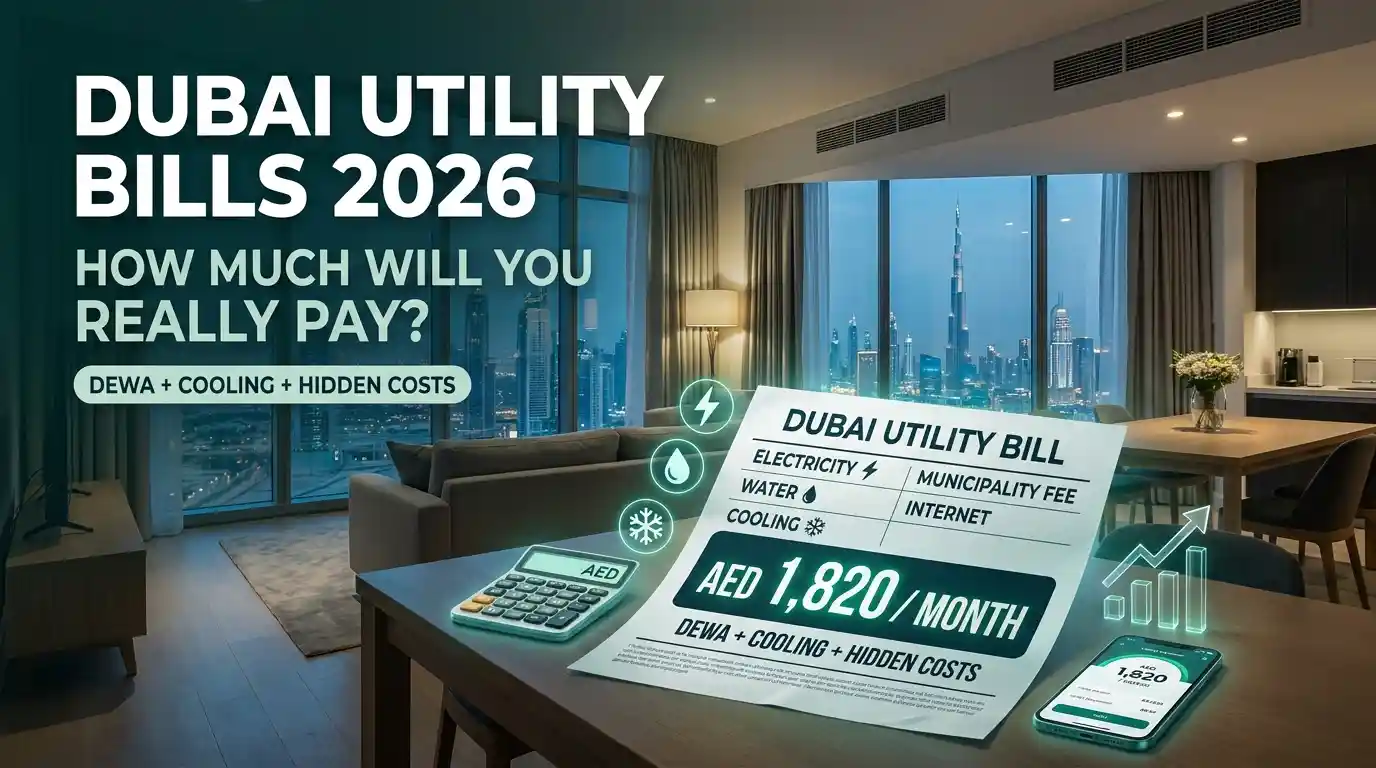
Rent negotiations get all the attention when someone is relocating to Dubai, and utilities get treated as an afterthought — usually guessed at somewhere between AED 300 and AED 500 a month. In reality, the number depends heavily on three things: whether your building has district cooling or a normal split AC unit, how large your household is, and how much VAT and fuel surcharge is layered on top of raw consumption. A studio with a chiller-free lease can genuinely cost AED 350 a month in utilities. A 3-bedroom villa with a private pool and garden during peak summer can push past AED 2,500 a month once electricity, water, and cooling are combined. This guide walks through every component so you can build a realistic monthly figure before you sign a tenancy contract, not after.
1. What is DEWA?
DEWA stands for the Dubai Electricity and Water Authority, the government-owned utility that generates and supplies electricity and water to almost every household, office, and business inside Dubai. Abu Dhabi has its own equivalent (ADDC), and Sharjah has SEWA, but the account structure and billing logic are broadly similar across all three. You can view live service updates, account tools, and official rate information directly on the DEWA official website.
DEWA operates through several channels that make account management fairly painless once you understand them:
- Online Account Portal: Used for opening accounts, paying bills, viewing consumption history, and requesting transfers or closures.
- Smart App: The DEWA mobile app lets you track daily consumption, set high-usage alerts, and pay bills directly from your phone or wallet.
- Customer Support: A call center and live chat handle activation issues, billing disputes, and meter complaints.
- Customer Happiness Centers: Physical branches across Dubai for anyone who prefers to open or close an account in person, or who is submitting documents that need manual verification.
2. Who Needs a DEWA Account?
Anyone taking legal occupancy of a property in Dubai needs their own DEWA account — the bill does not automatically transfer from the previous occupant, and living on someone else’s account is not a sustainable long-term setup. This applies across every property type:
- Tenants: Whether you are renting an apartment or a villa, the account must be opened in your name using your Ejari.
- Apartment Owners: Even if you own the unit outright, you still need an active DEWA account to receive supply.
- Villa Residents: Villas typically carry a higher security deposit due to higher expected consumption (gardens, pools, larger AC load).
- Business Owners: Commercial units require a separate business-category DEWA account, usually tied to a trade license copy instead of a personal Emirates ID.
- Homeowners transferring property: When a property changes hands, the new owner must open a fresh account rather than inherit the seller’s.
3. Documents Required to Open a DEWA Account
DEWA account activation is fairly quick as long as your paperwork is complete. Missing even one document is the most common reason applications get delayed. You will generally need:
- Passport copy (with a valid page showing your details).
- Valid UAE residence visa page.
- Emirates ID (or the application receipt if it’s still being processed).
- Ejari certificate for tenants (the registered tenancy contract number).
- Tenancy contract matching the Ejari details exactly.
- Title Deed instead of Ejari, if you are the property owner rather than a tenant.
4. How to Open a DEWA Account: Step by Step
Once your Ejari is registered, opening the account itself is usually the fastest part of the entire moving process.
- Choose your channel: Apply through the DEWA website, the Smart App, or visit a Customer Happiness Center in person.
- Fill the application: Enter your personal details, property details, and the meter number if the property is currently vacant.
- Upload documents: Attach your passport, visa, Emirates ID, and Ejari/title deed as scanned copies or photos.
- Pay the security deposit: This is due upfront and is refundable when you eventually close the account.
- Activation: Most online applications are approved and connected within a few working hours to one business day, provided documents are valid and the property is ready for supply.
If you’re moving between two properties, you can also request a “move” or transfer instead of closing one account and opening a new one, which usually keeps your consumption history intact and can speed up the paperwork.
5. DEWA Security Deposit
The security deposit is a refundable amount paid when opening the account, calculated based on the property type rather than your actual expected consumption. It sits with DEWA as a guarantee against unpaid bills and is returned — usually via bank transfer — once you formally close or transfer the account, minus any outstanding dues.
- Refund: Processed after final meter reading and account closure, typically within a few weeks.
- Cancellation: You must actively request account closure when you move out; it does not close automatically just because you stop paying.
- Transfer: If you move within Dubai, the deposit can often be carried over to the new address instead of being refunded and re-paid.
| Property Type | Approximate Security Deposit (AED) |
|---|---|
| Studio | 1,500 – 2,000 |
| Apartment (1-3 Bed) | 2,000 |
| Villa | 4,000 |
| Commercial / Business Unit | Based on load, often 4,000+ |
6. Electricity Charges
Your electricity bill is not just “units used × rate.” Three components typically stack together: base consumption slabs, a fuel surcharge that fluctuates monthly with global energy prices, and 5% VAT applied on top of the total. Consumption during peak summer months (June to September) can be two to three times higher than winter, purely because air conditioning runs almost continuously.
- Consumption Slabs: Rates increase as you use more electricity, so larger homes and higher AC usage push you into costlier tiers.
- Fuel Surcharge: A variable per-unit charge added monthly, tied to fuel costs — this is the line item most people don’t realize exists.
- VAT: A flat 5% is added to the final electricity charge.
- Peak Usage Effect: Running AC below 22°C constantly, using old appliances, or leaving devices on standby all noticeably inflate the bill.
| Apartment Size | Estimated Monthly Electricity (AED) |
|---|---|
| Studio | 150 – 300 |
| 1-Bedroom | 250 – 450 |
| 2-Bedroom | 400 – 700 |
| Villa | 800 – 1,800 |
7. Water Charges
Water is billed on a similar slab-based structure and is generally the smaller portion of your combined DEWA bill compared to electricity — unless the property has a private pool or a garden that needs regular watering, both of which push consumption up significantly.
- Single Occupant: Lightest usage bracket, minimal impact on the total bill.
- Family: Higher baseline from laundry, dishwashing, and multiple bathrooms in daily use.
- Villa with Garden: Outdoor irrigation is one of the biggest hidden water costs, especially in summer.
- Swimming Pool: Regular top-ups for evaporation can add a noticeable recurring cost on its own.
| Household Type | Estimated Monthly Water (AED) |
|---|---|
| Single Occupant | 40 – 80 |
| Family (Apartment) | 80 – 150 |
| Villa (No Pool/Garden) | 150 – 250 |
| Villa (Pool + Garden) | 300 – 600 |
8. Municipality Fee
This is one of the most misunderstood charges on the entire bill, and most expats genuinely don’t know it exists until they see it. Dubai Municipality applies a housing fee equal to 5% of your property’s annual rent, but instead of billing it as one lump sum, DEWA splits it into 12 equal monthly instalments and adds it directly onto your electricity and water bill every month — regardless of how much power or water you actually consumed that month.
How it’s calculated: Take your annual rent, multiply by 5%, then divide by 12. If your annual rent is AED 90,000, the math looks like this: AED 90,000 × 5% = AED 4,500 per year, divided by 12 months = AED 375 added to your DEWA bill every single month, whether you’re home or traveling.
People often see a DEWA bill of AED 700 in a mild month and assume electricity and water are just expensive, when in reality AED 375-450 of that could simply be the municipality housing fee tied to their rent, not their actual consumption. I remember genuinely double-checking my own meter reading the first month I saw this line item, convinced something was wrong — it wasn’t; it was just the housing fee doing exactly what it’s designed to do.
9. Sewerage Charges
Sewerage is generally bundled into your water consumption charge rather than appearing as a fully separate bill on most residential accounts. It is calculated as a percentage of water consumption and is included automatically once your account is billed for water usage. Some older or non-networked properties that rely on tankered water/drainage instead of the mains network may see additional charges reflected through the building or landlord rather than directly on the DEWA statement.
10. Empower, Emicool & Tabreed: District Cooling Explained
This is arguably the single most important section for anyone renting in a modern tower, because district cooling is billed completely separately from your DEWA account, and the amounts involved catch more people off guard than any other utility on this list.
What is Empower? Empower is one of the largest district cooling providers in Dubai, alongside Emicool and Tabreed. Instead of your apartment having its own AC compressor, the entire building (or community) is connected to a centralized chilled-water plant that pumps cooling to every unit. You don’t pay DEWA for this — you get a completely separate monthly invoice from whichever provider services your building. You can check official rates and account tools directly through Empower, Emicool, or Tabreed, depending on which one serves your building.
- Connection Fee: A one-time charge to connect your unit to the cooling network when you move in.
- Deposit: A refundable security deposit, similar in concept to the DEWA deposit but billed and held by the cooling company separately.
- Capacity Charge: A fixed charge billed regardless of consumption, essentially a “reservation fee” for your share of the chilling plant’s capacity.
- Consumption Charge: The variable portion based on actual cooling used, which spikes hard between June and September.
- Hidden Charges: Late payment penalties, reconnection fees if disconnected for non-payment, and administrative charges for account transfers.
| Unit Size | Estimated Monthly Cooling (AED) — Peak Summer |
|---|---|
| Studio | 250 – 450 |
| 1-Bedroom | 350 – 600 |
| 2-Bedroom | 600 – 1,000 |
| 3-Bedroom / Townhouse | 900 – 1,400 |
Areas That Commonly Use District Cooling
Always ask your landlord or agent directly whether a unit is “chiller-free” (landlord absorbs cooling cost) or on direct district cooling billing before signing — this single detail can change your monthly utility budget by several hundred dirhams.
11. Gas Bills
Not every building has piped gas, and this affects your monthly bill structure noticeably.
- Central Gas Supply: Buildings connected to a piped network (often via providers like Emirates Gas or Lootah Gas) bill consumption monthly, usually as a modest, predictable charge.
- Cylinder Gas: Older or lower-rise buildings still rely on refillable gas cylinders, delivered and swapped by local suppliers, paid per cylinder rather than monthly.
Average Monthly Cost: Central piped gas typically runs AED 20 to AED 60 per month for an average household, while a single cylinder swap generally costs around AED 90 to AED 120, lasting one to two months depending on cooking frequency.
12. Internet Bills
Home internet in the UAE is fast and reliable, delivered through a duopoly of Etisalat and du (Virgin Mobile also operates on du’s infrastructure). The trade-off is that contracts typically lock you in for 12 to 24 months, and switching mid-contract usually involves an exit penalty.
- Installation: Often free or discounted when bundled with a new contract, but can be a standalone charge otherwise.
- Router: Usually provided free on contract, though a deposit or replacement fee may apply if not returned on cancellation.
- Packages: Range from entry-level fiber to gigabit-speed plans, often bundled with a TV package or a mobile SIM.
| Package Type | Estimated Monthly Cost (AED) |
|---|---|
| Basic Fiber (~250-500 Mbps) | 299 – 389 |
| Mid-Tier Fiber (~1 Gbps) | 400 – 550 |
| Bundled Internet + TV | 450 – 650 |
13. Mobile Bills
Both prepaid and postpaid options are widely available, and tourists/short-stay visitors have their own simplified SIM options.
- Prepaid SIM: No contract, top up as needed — a practical choice for the first few weeks before settling on a postpaid plan.
- Postpaid SIM: Monthly billed plans with bundled data, minutes, and often a “free” device on a 12-24 month commitment.
- Tourist SIM: Short validity data packages available at airports and telecom stores, priced for visitors rather than residents.
Average Monthly Cost: A standard postpaid plan with 10-20GB local data and some international minutes typically runs AED 150 to AED 250 per month per line.
14. Hidden Bills Most Expats Forget
This is the section that ends up mattering most in practice, because almost none of these appear on a rental listing, yet nearly all of them show up within your first month of moving in. For a deeper breakdown of the move-in side specifically, see our Hidden Housing Costs guide.
| Hidden Charge | Typical Cost / Note |
|---|---|
| DEWA Deposit | AED 2,000 – 4,000, refundable |
| Municipality Fee | 5% of annual rent, billed monthly |
| District Cooling Deposit | Separate from DEWA deposit |
| Cooling Consumption | Spikes hard in summer months |
| Internet Installation | Sometimes waived on contract |
| Router Charges | Deposit/replacement if not returned |
| Moving Charges | Movers, truck, packing materials |
| Parking | Not always included with unit |
| Salik (Toll) | AED 4 per gate, adds up commuting |
| Building Access Card | Deposit for lobby/parking access |
| Maintenance | Sometimes charged separately by building |
| AC Cleaning | Recommended every few months |
| Pest Control | Periodic service, often tenant-arranged |
| Garbage Fee | Applicable in some buildings/communities |
| Ejari Registration | Around AED 220 |
| Agency Fee | 5% of annual rent |
| Security Deposit (Rent) | 5-10% of annual rent |
| Furniture | Significant if renting unfurnished |
| Moving Company | Varies by volume and distance |
15. Monthly Utility Cost Examples
Real budgeting only makes sense once every bill is combined into one monthly figure. Here is a realistic estimate across four household profiles, assuming a district-cooled apartment where applicable.
| Item | Bachelor (Studio) | Couple (1-Bed) | Family (2-Bed) | Villa (3-Bed) |
|---|---|---|---|---|
| Electricity | 200 | 350 | 550 | 1,200 |
| Water | 50 | 90 | 130 | 250 |
| Municipality Fee | 150 | 250 | 375 | 650 |
| Cooling (District) | 300 | 450 | 750 | 1,100 |
| Internet | 299 | 350 | 450 | 550 |
| Mobile | 150 | 300 | 450 | 600 |
| Gas | 0 | 30 | 50 | 60 |
| Estimated Total (AED) | ~1,150 | ~1,820 | ~2,755 | ~4,410 |
These are peak-summer estimates — winter months typically run 25-40% lower due to reduced cooling load. When I compare my own winter and summer bills side by side, the swing is genuinely one of the biggest single differences in my monthly budget all year — bigger than almost any other line item shifting seasonally.
16. Hidden Costs When Moving to Dubai
Utility bills are only one part of the “move-in shock.” The larger upfront cash requirement usually comes from these one-time costs, paid before you’ve even switched on the lights:
- Rental Deposit: Typically 5% (unfurnished) to 10% (furnished) of annual rent.
- Agency Commission: Standard rate is 5% of the annual rent.
- DEWA Deposit: AED 2,000 – 4,000 depending on property type.
- Internet Installation: Occasionally waived, otherwise a modest one-time fee.
- Furniture: A major cost if the unit is unfurnished — beds, sofas, appliances, dining sets.
- Kitchen Items: Cookware, crockery, small appliances add up quickly from scratch.
- Curtains: Rarely included by landlords, often custom-made per window size.
- Parking: Some buildings charge separately for a dedicated bay.
- Car Registration: If bringing or buying a car, registration and plates carry a real cost.
- Insurance: Mandatory car insurance, plus optional but recommended contents/home insurance.
For the full move-in cost breakdown beyond utilities specifically, our Rent in Dubai guide covers rental deposits and agency fees in more detail.
17. Money Saving Tips on Utility Bills
- Switch to LED Lighting: Lower wattage across every room adds up meaningfully over a year.
- Reduce AC Load: Keeping the thermostat at 24°C instead of 18-20°C can noticeably cut cooling consumption. This was genuinely the single change that made the biggest visible dent in my own bill — I moved from 20°C to 24°C one month purely as an experiment and the drop showed up clearly on the next statement.
- Run Heavy Appliances at Night: Washing machines and dishwashers run cooler and often cheaper during off-peak hours.
- Install a Smart Thermostat: Scheduling AC to reduce cooling when you’re out of the house prevents wasted consumption.
- Compare Internet Plans Annually: Providers frequently run promotions for new or renewing customers — it pays to check before auto-renewing.
- Consider Annual Packages: Some internet and mobile providers offer discounted annual pre-payment versus monthly billing.
- Monitor Consumption via the App: Checking the DEWA Smart App regularly helps you catch unusual spikes before the bill arrives.
18. Common Billing Mistakes
- Unexpectedly High Bill: Usually caused by a spike in AC usage, a forgotten appliance left running, or a change in season.
- Meter Issues: A faulty or misread meter should be reported immediately for a technician visit and re-verification.
- Cooling Bill Confusion: Many tenants mistakenly assume cooling is included in DEWA when it’s actually billed by a separate provider entirely.
- Wrong Municipality Fee: If your rent changes (renewal at a different amount), make sure the fee updates accordingly rather than continuing at the old rate.
- How to Complain: Disputes can be raised via the DEWA app, customer service line, or in person at a Customer Happiness Center, typically with your account number and recent bill on hand.
19. How to Pay Your Bills
Dubai’s utility payment infrastructure is genuinely convenient, with several overlapping channels available:
- DEWA App: Direct in-app payment linked to your account.
- DubaiNow App: A government “super app” that consolidates DEWA and several other government bill payments in one place.
- Bank Payment: Most UAE banks allow bill payment directly through online or mobile banking.
- Apple Pay / Google Pay: Supported for quick one-tap payments through the DEWA app or DubaiNow.
- Auto Pay: Link a card for automatic monthly deduction so you never miss a due date.
- Payment Kiosks: Self-service kiosks located at malls and DEWA offices for cash or card payment.
20. Frequently Asked Questions
DEWA is the Dubai Electricity and Water Authority, the government body responsible for supplying and billing electricity and water to almost every home and business in Dubai.
On its own, electricity and water consumption is moderate. What makes the total bill feel expensive is the municipality housing fee bundled in, which is unrelated to actual consumption.
Roughly AED 2,000 for apartments and AED 4,000 for villas, refundable when the account is closed.
Yes, if you move to a new address within Dubai you can usually request a transfer rather than closing and reopening a fresh account.
Most online applications with complete documents are activated within a few working hours to one business day.
The most common causes are increased AC usage during hotter months, a rent increase raising the municipality fee, or an appliance left running continuously.
No. If your building uses district cooling (Empower, Emicool, or Tabreed), it is billed entirely separately from DEWA.
Typically no — DEWA accounts are opened in the tenant’s name and the tenant is responsible for ongoing payment, unless explicitly agreed and arranged otherwise in the tenancy contract.
It equals 5% of your annual rent, divided into 12 equal monthly instalments added to your DEWA bill.
No, gas is billed separately, either through a piped central gas provider or via cylinder delivery, depending on the building.
Unpaid bills can lead to a disconnection notice, and reconnecting supply afterward usually involves an additional reconnection fee.
Yes, internet is billed by a telecom provider (Etisalat, du, or Virgin) and is entirely separate from your DEWA account.
Yes, the DEWA Smart App shows daily and monthly consumption trends so you can catch unusual spikes early.
Yes, once you formally close the account and clear any outstanding balance, the deposit is refunded, usually via bank transfer.
No — many older or lower-rise buildings still use individual split AC units, which are billed only through your regular DEWA electricity charge.
Generally yes, due to larger cooling loads, garden irrigation, and potentially a private pool, all of which raise both the water and electricity components.
Yes, as long as your Ejari is registered and the property is ready to receive supply, you can activate the account ahead of your move-in date.
No, the deposit is based on property type (studio, apartment, villa, commercial) rather than household composition.
Significantly — cooling consumption can rise two to three times higher between June and September compared to cooler months.
Yes, both Apple Pay and Google Pay are supported through the DEWA app and the DubaiNow app for quick bill payment.
Raising it directly through the DEWA app or customer service line with your account number and the disputed bill on hand is typically the fastest route.
Fee structures and rate logic cross-checked against publicly available information from DEWA and the district cooling providers named above (Empower, Emicool, Tabreed) at the time of writing. Personal examples in this guide are illustrative, drawn from real, commonly reported cost ranges rather than presented as audited individual statements. Rates and fees are updated periodically — always confirm current charges directly through the official DEWA app or website before budgeting around them.

Written & Reviewed by Asad Bukhari
Asad moved to Dubai over 20 years ago to work as a newspaper reporter covering city and relocation news, and has been reporting on the city ever since. Over the years he expanded that first-hand knowledge of Dubai’s neighbourhoods and relocation process into his own real estate business, which he still runs today. This guide draws on both his journalism background and his hands-on property experience.
Pingback: Ejari Registration Guide (2026): How to Register Your Tenancy Contract in Dubai