
Remote Jobs in Dubai (2026): Virtual Working Programme, Hybrid Roles, Salaries & How to Apply
“Remote jobs in Dubai” actually covers two structurally different situations, and mixing them up wastes real time. One path is living in Dubai on the Virtual Working Programme while working for a company based somewhere else entirely — a route that got noticeably stricter in 2026. The other is a genuine remote or hybrid role with a UAE-based employer, sponsored exactly like any standard job. This guide walks through both paths in full: the updated visa rules, realistic salaries, the sectors actually hiring, and how to apply for each.
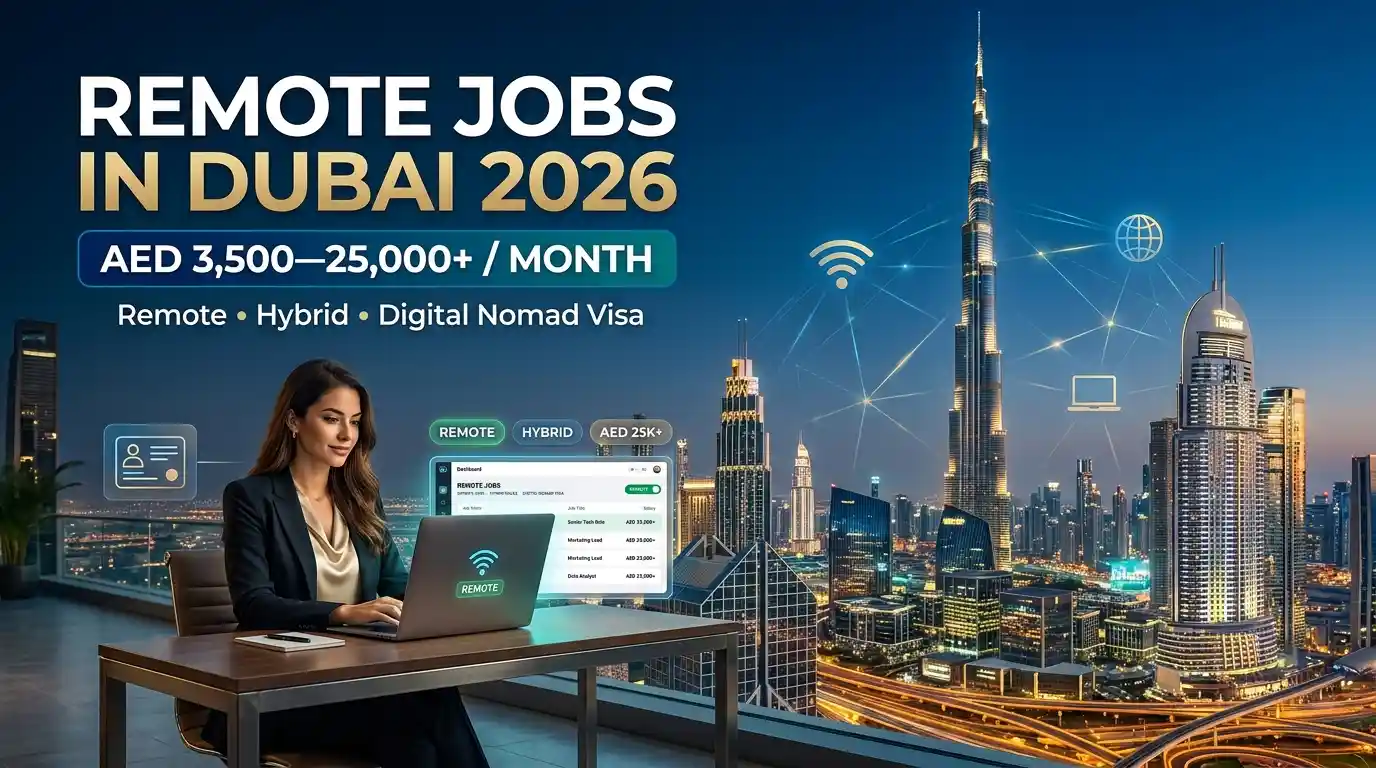
*See the Virtual Working Programme section below — the 2026 income threshold is reported inconsistently across sources and is flagged accordingly.
Overview: What “Remote Jobs in Dubai” Actually Means
Flexible and remote working has become a genuine part of how the UAE frames its labour market, backed by continued investment in the country’s digital economy and by the government’s own decision in mid-2026 to fold AI, digital government, and — notably — “Remote Work Applications” under a single new federal authority reporting to Cabinet. But the phrase “remote job in Dubai” still covers two structurally different situations, and knowing which one you’re actually after changes everything about how you search, apply, and which visa route you need.
The Two Real Paths
Path 1: Digital Nomad — Living in Dubai, Working for a Foreign Employer
Path 2: Hybrid/Remote Employee of a UAE-Based Company
If a listing says “remote — UAE-based company,” that’s Path 2, and you’ll need to be eligible for a standard UAE work visa exactly as you would for any office role. If it says “work remotely from Dubai for a company based abroad,” that’s Path 1, and the Virtual Working Programme is the relevant route. See our full UAE Work Visa Guide for the standard employer-sponsored process.
The Virtual Working Programme (Digital Nomad Visa) — Updated for 2026
The Virtual Working Programme lets foreign professionals live in Dubai while working remotely for an employer or business registered outside the UAE — no local sponsor or job offer required. It has existed since 2020, but several immigration-industry sources report it was tightened materially in 2026, and not every guide online reflects that yet.
Eligibility and Documents
- Who can apply: Remote employees with a contract of at least one year, or freelancers/business owners with a company or client base registered outside the UAE for at least one year.
- Minimum income: The long-published baseline is USD 3,500/month for employees and roughly USD 5,000/month for business owners. See the warning box below on the 2026 change.
- Core documents: a passport valid for at least six months, a passport-style photo, an employment contract or business ownership proof, a salary certificate or payslips, recent bank statements, and UAE-valid health insurance.
- Processing: entry permit issuance is commonly quoted at around 5–7 business days once a complete file is submitted; the medical fitness test and Emirates ID biometrics after arrival add further time.
- Validity: a one-year residence permit, renewable, with the ability to sponsor a spouse and dependent children.
Fees
Government fee figures vary noticeably across sources, and this is another area worth confirming before you pay anything. Older guides quote total government charges around AED 3,000–4,000; more recent mid-2026 reporting points to a reduced schedule of roughly AED 1,500–1,700 including the Emirates ID, with health insurance billed separately. Given how often this fee schedule is revised, confirm the current figure on the official portal rather than relying on any third-party number, including this one.
Important Restrictions
- You cannot take up employment with a UAE-registered company on this visa without converting to a standard sponsored employment visa or a freelance permit.
- Visa holders should not remain outside the UAE for more than six consecutive months without risking invalidation.
- Renewal requires meeting the eligibility criteria in force at the time of renewal, not the criteria that applied when you first received the visa.
Hybrid & Remote Roles at UAE Companies
This is a genuinely different category from the Virtual Working Programme: an actual position with a UAE-registered employer that happens to be remote or hybrid rather than fully office-based. These roles are sponsored exactly like any standard employment visa — the only difference is where you physically sit each day, and under UAE labour law that arrangement must be written into your contract, not agreed informally.
- Customer Service & Support: roles based in or serving Dubai, often requiring local market knowledge and UAE timezone availability.
- Sales & Business Development: managing regional pipelines (UAE, GCC, sometimes global) from a remote or hybrid base — see our companion Sales Jobs in Dubai guide for commission structures.
- Marketing: many Dubai marketing and digital agencies now run largely remote internal teams.
- Finance & Accounting: bookkeeping, invoicing, and financial reporting roles increasingly offered remotely for smaller UAE companies.
- Content & Media: editing, writing, and content production roles for UAE-based media and marketing companies.
Top Sectors Hiring Remote in 2026
FinTech & Digital Banking
IT, AI & Cybersecurity
Virtual Assets & Blockchain
Professional & Consulting Services
Skills That Matter for Remote Roles
Salary Guide
| Role Type | Monthly Salary (AED) |
|---|---|
| Remote Customer Service Representative | 3,500–6,000 |
| Remote Content Writer / Editor | 5,000–9,000 |
| Remote Digital Marketer | 6,000–12,000 |
| Remote Accountant / Bookkeeper | 5,000–9,000 |
| Remote Software Developer | 10,000–20,000+ |
| Remote Data Scientist / MLOps | 14,000–25,000+ |
| Remote Sales / Business Development | 8,000–16,000 + commission |
| FinTech Compliance / Financial Engineering | 12,000–22,000+ |
These are indicative ranges built from current 2026 job-market listings rather than a single official wage survey, so treat them as a planning benchmark. A useful rule of thumb: to consistently clear around AED 10,000/month remotely, focus on building in-demand, verifiable skills — digital marketing, programming, or design — backed by a strong portfolio, rather than chasing volume across low-paying gig platforms. Our Cost of Living in Dubai guide and Monthly Budget for a Single Person guide can help you check whether a given offer actually covers your expenses.
Employers Associated With Remote & Hybrid Work
Digital Banks — Wio Bank, Zand
Fintech & InsurTech — Bayzat, Tabby
Tech-Driven Platforms — Careem, Property Finder
DIFC & ADGM-Registered Firms
Company examples are provided as sector illustrations, not confirmed current vacancy listings — always check each employer’s own careers page for live openings.
How to Apply
Path 1: Applying via the Virtual Working Programme
Path 2: Applying to a Hybrid or Remote UAE Employer
LinkedIn (filter for Remote + UAE)
Bayt & GulfTalent
Company Career Pages
DIFC & ADGM Company Portals
Recruitment Agencies with Remote Desks
Direct Applications to FinTech & Tech Employers
For Path 2, the process is close to any standard Dubai job search: apply, interview (often two rounds), receive an offer, then the employer processes your visa exactly as it would for an office role. When browsing listings, always check whether the role is tied to a UAE-registered employer or to an international company willing to sponsor remote hires under the Virtual Working Programme instead — the visa path differs completely between the two. Several recruitment agencies also run dedicated remote and hybrid desks — see our Recruitment Agencies in Dubai guide for verified options.
Field Notes: What Remote Work in Dubai Is Actually Like
The profiles below are composite illustrations built from patterns commonly reported by remote and hybrid workers in the UAE — presented as representative scenarios, not verified individual case files.
Composite profile: Virtual Working Programme applicant
A frequently reported pattern for a first-time applicant is underestimating how document-heavy the process has become since the 2026 tightening — six months of clean, consistent bank statements is a common sticking point for freelancers with irregular income, more so than for salaried remote employees with a single steady payslip. Applicants who apply through an assisted service commonly report a smoother document-review stage, though at an added cost over the government fee itself.
Composite profile: hybrid employee at a Dubai fintech
A commonly reported pattern among hybrid hires at DIFC-adjacent fintech and digital-banking employers is a fixed two- or three-day office schedule anchored around team stand-ups and client-facing days, with the remaining days worked from home. Employees moving from a fully office-based role in their home country frequently cite Dubai’s timezone position — bridging European mornings and Asian afternoons — as the most useful practical feature of the arrangement, rather than the remote element itself.
Avoiding Remote Job Scams
Living Cost as a Remote Worker
Remote workers on the Virtual Working Programme need to independently budget for the full cost of living in Dubai, since there’s no employer-provided accommodation or benefits package to offset it. For full category-by-category cost breakdowns, see our Monthly Budget for a Single Person guide, our Cost of Living in Dubai guide, and our Best Areas to Live in Dubai guide if you’re choosing a neighbourhood around commute-free days.
Common Mistakes to Avoid
Frequently Asked Questions
The Virtual Working Programme is a self-sponsored residence visa for people working for employers or clients based outside the UAE while living in Dubai; a remote or hybrid UAE job is a standard employer-sponsored role with a UAE-registered company that simply doesn’t require daily office attendance.
No — you need proof of existing remote employment or self-employment with a company or clients based outside the UAE, plus income documentation. A UAE job offer is not required, and in fact this visa does not permit local UAE employment.
The long-standing published threshold is USD 3,500/month for employees and around USD 5,000/month for business owners. Several 2026 immigration sources report a January 2026 GDRFA/ICP circular that raised the employee threshold to USD 5,000/month as well, alongside a longer six-month bank-statement requirement — this isn’t uniformly reflected across all guidance yet, so confirm the live figure on the GDRFA or ICP portal before applying.
Entry permit issuance is typically quoted at around 5-7 business days once a complete file is submitted, with the medical fitness test and Emirates ID biometrics adding further time after arrival — budget several weeks in total.
No — it is specifically for people working for employers or clients based outside the UAE. Taking a role with a UAE-registered company requires converting to a standard employer-sponsored work visa or obtaining a freelance permit instead.
Job-market trackers describe hybrid and remote arrangements as an established part of Dubai and Abu Dhabi private-sector hiring, but a single, precisely-sourced official percentage isn’t consistently traceable across current reporting, and some mid-2026 hiring commentary suggests many employers are pulling back toward 3-5 office days a week, with fully remote roles increasingly reserved for senior specialists.
Fintech and digital banking, IT/AI and cybersecurity, virtual assets and blockchain (centred on DIFC and ADGM), and professional/consulting services are the sectors most associated with remote and hybrid hiring.
The UAE levies no personal income tax on salary or remote earnings; however, your foreign employer’s home-country tax rules, and possibly your own citizenship-based tax obligations, may still apply separately.
Yes — some companies hire globally for remote-first roles, though many UAE employers still prefer candidates already resident in the country, since a hybrid schedule usually requires being physically present some days each week.
Roughly AED 3,500 to AED 25,000+ per month depending on role and seniority, with entry-level customer service and content roles at the lower end and senior tech, data, or fintech compliance roles at the top.
Yes — the programme allows sponsorship of a spouse and dependent children, subject to meeting the standard family-sponsorship documentation and insurance requirements.
Yes — valid UAE health insurance is a standard residency requirement under either route, and several 2026 reports describe a higher mandatory coverage level of around AED 500,000 now being applied to Virtual Working Programme applicants.
Never pay an upfront fee for a “guaranteed” remote placement, verify company legitimacy independently, and be cautious of offers with no real interview process.
Yes — remote and hybrid customer service roles are common, especially those requiring UAE timezone availability and familiarity with the local market.
Yes — it covers both remote employees and freelancers or business owners with income from clients or a company based outside the UAE, though business owners typically face a higher income threshold and must show at least one year of company ownership.
Clear written communication, fluency with collaboration tools, cross-cultural awareness across UAE, GCC, and global teams, strong self-management, and — for freelance-adjacent roles — a verifiable portfolio or track record.
Hybrid arrangements are generally more common than fully remote ones, as UAE employers increasingly balance flexibility with a set number of required in-office days each week.
No — it is for continuing remote employment or operating a business already registered abroad, not for running a UAE-based business, which requires a separate trade licence and visa route.
Digital banks such as Wio Bank and Zand, fintech and insurtech firms such as Bayzat and Tabby, and tech-driven companies such as Careem and Property Finder are among those commonly associated with flexible or hybrid working models in the UAE.
Tax-free personal income, strong connectivity and infrastructure, and a large international professional community make Dubai a popular base for remote workers, though the tightened 2026 Virtual Working Programme criteria mean the application itself now takes more preparation than in prior years.
- Virtual Working Programme requirements cross-checked against multiple independent 2026 immigration-industry sources; where those sources conflicted on the current income threshold, both figures are presented and flagged rather than one being asserted as settled.
- The reported January 2026 GDRFA/ICP tightening circular is sourced from immigration-industry news coverage rather than a single primary government release, so it’s presented as a widely reported development to verify directly, not a confirmed government figure.

Written & Reviewed by Haleema Bukhari
Haleema moved to Dubai at age five and built her career as an HR Manager before starting her own career coaching practice. With over 10 years of experience in recruitment and HR consulting in Dubai, she provides expert advice on job search, hiring trends, and relocation.
Pingback: Ultimate Dubai Relocation Checklist (2026): Free Tools & Calculators