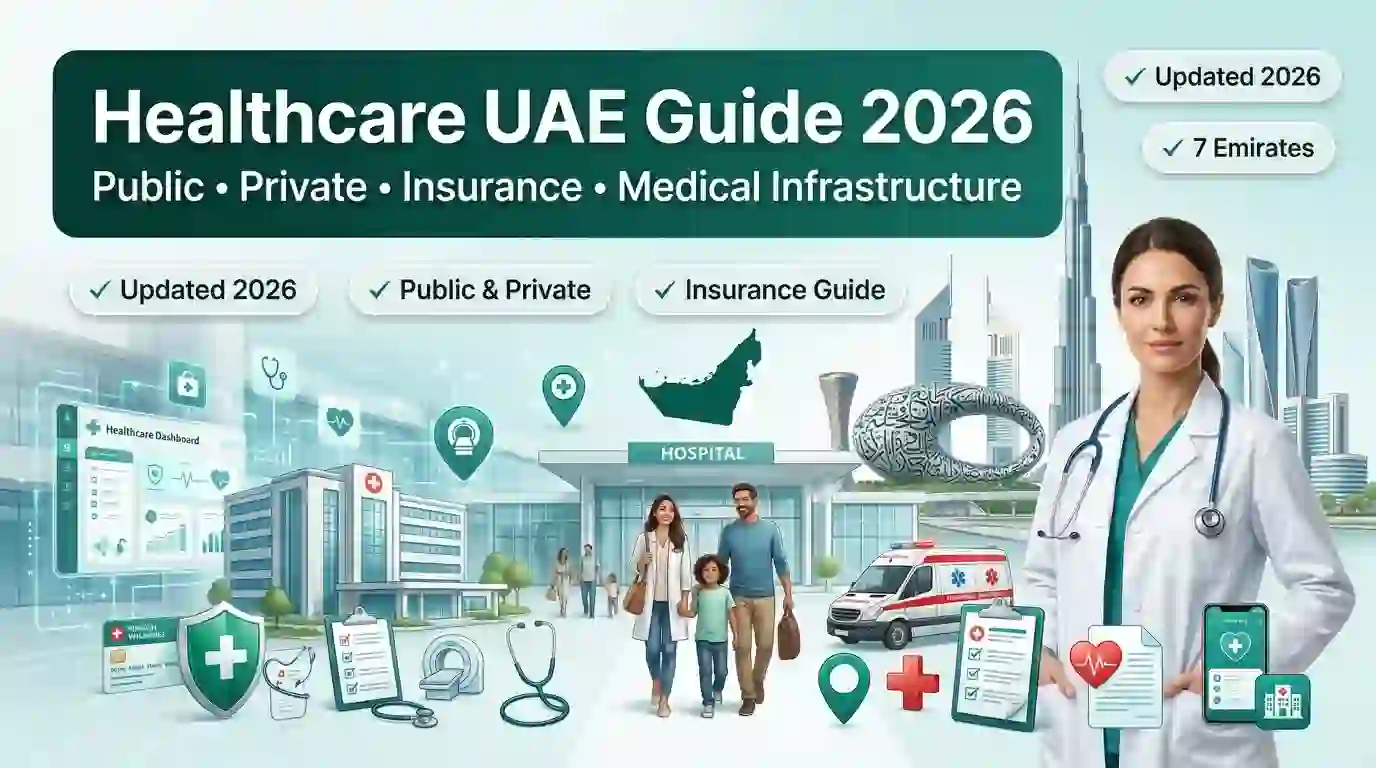
Healthcare UAE Guide (2026): Public, Private, Insurance & Medical Infrastructure
A realistic look at how federal laws, regulatory bodies, and insurance networks function across all seven emirates, along with the actual day-to-day challenges residents face when accessing medical care.
1. The Reality of UAE’s Healthcare Grid
Over the last two decades, the UAE has invested heavily in healthcare infrastructure. Today, residents and visitors have access to modern hospitals, specialist clinics, and advanced medical technologies across all seven emirates. However, navigating this system isn’t just about walking into the nearest clinic—it is heavily dependent on your specific visa location and insurance tier.
Unlike unified systems where one card works everywhere, the UAE operates on a localized model wrapped in a federal framework. If you are tracking your setup via the Healthcare in Dubai guidelines, you will notice significant structural shifts when crossing borders into neighboring emirates.
2. Official Citations: The Regulatory Framework
Three distinct government bodies manage the licensing, medical compliance, and operational rules across the country. Understanding who holds authority in your area prevents legal or visa alignment errors.
- MOHAP (Ministry of Health and Prevention): Oversees federal health policy, drug registrations, and directly runs public facilities across the Northern Emirates.
- DoH (Department of Health – Abu Dhabi): Regulates the capital’s footprint, managing the comprehensive Healthcare Abu Dhabi network.
- DHA (Dubai Health Authority): Directs licensing and local healthcare strategies within Dubai’s borders.
The Centralized Hierarchy Flow
To keep clinical histories transparent, the federal government uses Riayati (and Abu Dhabi uses Malaffi)—centralized digital patient databases that link records across facilities. The system visually tracks downward from legislative bodies to physical endpoints:
3. Healthcare Infrastructure by Emirate
Medical infrastructure changes structurally based on which emirate issues your residency. Here is how the grid splits across locations:
Abu Dhabi & Al Ain
Managed locally by the DoH and operated largely through the SEHA network alongside private providers. Coverage rules here are highly rigid, making employer-sponsored insurance mandatory for dependents as well as employees.
Dubai
Driven primarily by a massive private corporate environment under DHA oversight. It separates core residential healthcare from free-zone ecosystems like Dubai Healthcare City (DHCC).
Sharjah
Operates under a mix of MOHAP regulations and the Sharjah Health Authority (SHA). Residents looking at Healthcare Sharjah rely on a blend of community-centered clinics and direct pathways to public hospital centers.
Ajman, RAK, UAQ, & Fujairah
These emirates rely on Emirates Health Services (EHS) networks and MOHAP-managed public hospitals. While private clinics exist, heavy clinical interventions or complex surgical emergencies often route to central government institutions.
4. The Drawbacks: Insurance Approvals & Network Friction
Let’s be direct: the system has structural bottlenecks that catch expats off guard. The most common friction point is the insurance pre-approval process. For basic plans, pharmacies and clinics must submit digital requests for therapies, specialized scans (like MRIs), or specific brand-name medicines. It is common to wait 30 to 45 minutes inside a facility just for an authorization code to clear.
Basic policies frequently exclude premium hospital networks entirely. Furthermore, while medicine pricing is capped nationally by MOHAP, specific imported chronic illness medications remain expensive if your co-pay structures are high or if your plan utilizes strict formulary limits.
Another daily reality is parking stress. Major private facilities in high-density areas suffer from severe parking shortages during evening consultant hours, forcing reliance on paid valet setups.
5. Public vs Private Sector Realities
Many expats first visit nearby Aster or NMC clinics for common illnesses because appointments are usually available on the same day. However, for severe trauma or specialized medical conditions, public networks maintain the heavy machinery and staff depth.
| Operating Dynamic | Public Sector (SEHA / EHS / DHA) | Private Sector (Corporate Groups) |
|---|---|---|
| Primary Focus | Trauma response, national wellness, citizens | Outpatient care, elective surgeries, expats |
| Insurance Alignment | Requires specific government tiers / high co-pay | Direct billing with standard Medical Insurance Dubai plans |
| Operational Pacing | Triage-based; non-urgent care has longer timelines | Rapid, consumer-focused appointment schedules |
| Struggles | Bureaucratic registration pipelines | High risk of over-testing to max out insurance codes |
6. Labeled Medical Infrastructure Directory
When selecting a destination for medical care, evaluating core operational capacities saves critical hours. Here is a breakdown of top-rated national facilities with clear performance markers.
Cleveland Clinic Abu Dhabi
Al Maryah Island, Abu Dhabi, UAECleveland Clinic Abu Dhabi addresses complex and critical care requirements unique to the regional population. Operating under a direct physician-led model, this facility eliminates standard private care fragmentation by keeping diagnostic and surgical specialists aligned under one tracking roof. The structural layout is heavily digitized, integrating patient data directly with global research hubs. It functions as a primary referral point for cardiovascular, neurological, and oncological interventions across the GCC. The environment prioritizes low noise and precise clinical control to ensure stable post-operative recovery phases.
Mediclinic City Hospital
Dubai Healthcare City (DHCC), Dubai, UAEMediclinic City Hospital provides comprehensive multi-specialty care within Dubai’s dedicated healthcare free zone. Known for its strong obstetrics, advanced orthopedic units, and specialized oncology wing, it represents the standard corporate-run hospital infrastructure favored by the city’s western expat demographic. The facility manages outpatient flows effectively, reducing typical diagnostic wait intervals through centralized laboratory tracking. It features dedicated pediatric emergency spaces to keep young patients separated from standard acute trauma cases. Clinical staffing draws from an international pool with board certifications aligned with western regulatory models.
7. Evolution of the UAE Medical Ecosystem
The transformation of this network followed structured regulatory milestones rather than organic development. This timeline tracks how the framework reached its current 2026 status:
8. Frequently Asked Questions
By federal law, any UAE hospital must accept and stabilize emergency cases under 998 dispatch protocols. Financial clearing or network transfer arrangements occur only after stabilization.
Because the private system runs on a fee-for-service model. Always ask your physician if a prescribed test is diagnostic mandatory or merely exploratory before letting them swipe your card.
You can lodge an official dispute directly through the Sanadak platform (for Abu Dhabi/Federal) or the eClaim portal via DHA (for Dubai).